
Thursday was dry and mild with sunshine at times so leaving B to garden D and I journeyed to Arthur's Stone. It took about 50 minutes and in actual fact is only about 5 minutes further than Brobury House Gardens and Bredwardine. D has wanted to visit the chambered tomb for ages.
Arthur's Stone, looked after by English Heritage, is an atmospheric 5000 year old burial chamber made of stone slabs set on Merbach Hill 280 metres above sea level. It overlooks Herefordshire's Golden Valley. It dates from around 3500BC and is 1 of the most northerly chambered tombs of the Severn Cotswold Group which is a series of 200 Middle and Late Neolithic monuments scattered all over the SW Midlands and Central Wales.
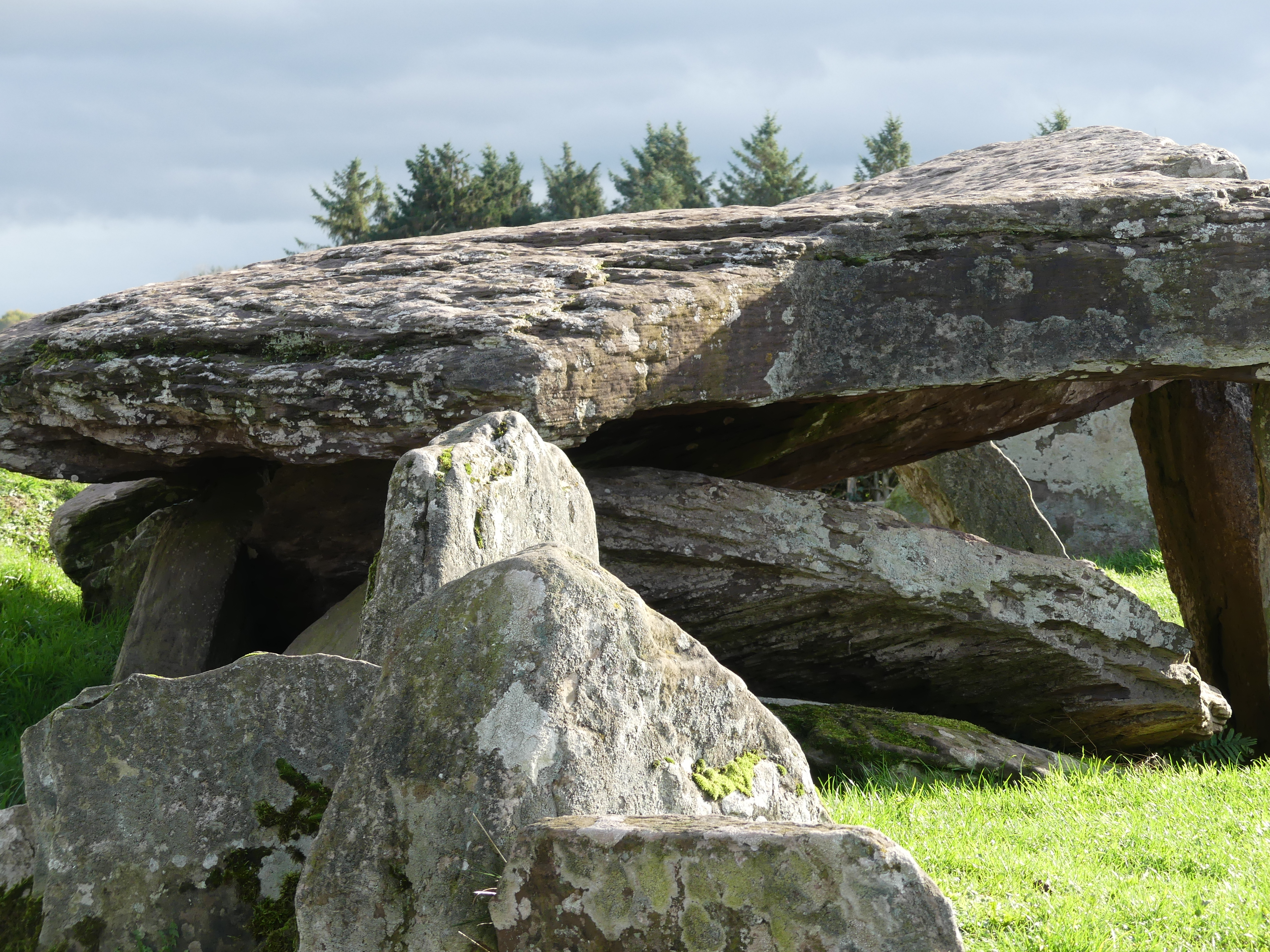
It is one of a possible five tombs that are found in the Neolithic landscape of the Northern Marches of the Golden Valley. This area is rich in long barrows and standing stones. Flint scatters and stone axes have been found which illustrate use of the Upper Golden Valley throughout the Neolithic. Originally Arthur's Stone was covered by an oval mound 26 metres by 17 metres and the tomb has nine upright stones which form a polygonal chamber. An unusual right angled passage at the entrance can be seen in one of the photos below. The huge capstone is believed to weigh about 25 tonnes.

The size and weight of the uprights and capstone suggest it took a long time to build and many people would have been involved in its construction. Bill Startin (1981) suggests a tomb like this might have taken between 7000 and 15000 hours labour to construct.

Folklore
One legend suggests it gets its name because King Arthur fought a batttle here. Arthur was killed and buried inside the chamber. Another story suggest that there was a battle between Arthur and a giant. The latter was killed and fell on the stones with his elbows creating hollows on one of the stones.
The stones marking what is probably a false entrance contain cupmarks. Little is known about these but they date from the Bronze Age. They may have been due to defacement or re-use of the tomb for social and political rather than ritual purposes. The one upright has 12 cupmarks. I did look for them but failed to find any! However later research suggests they are only a few cms in diameter and I was looking for something much bigger.


The capstone split into pieces is orientated NE to SW with the latter end pointing towards the southern section of the Golden Valley and towards the Black Mountains.


It is unlikely it was was just used as a tomb. Rituals of the ancestors when claims to a particular area of land could be made, may have taken place here. The tomb is in an area of summer pasture and Neolithic people may have met here on a seasonal basis.


It is possible the stone provided inspiration for CS Lewis as in the Lion, the Witch and the Wardrobe the stone table on which Aslan was sacrificed may have been based on the monument. I believe Tolkien and C S Lewis used to walk in the area.


Some people who have visited the stone have heard a strange low frequency buzzing sound that gets louder and louder before suddenly ceasing. No normal source for this noise has been found.


Last summer archaelogists were granted permisssion to excavate part of the site.
Features unearthed include what could be stone steps leading up to the tomb and Neolithic tools. Drones were used to look for possible signs of other ancient burial sites nearby which could mean that Arthur's Stone was an important meeting place like Avebury or Stone Henge.


After leaving Arthur's Stone we drove to the village of Dorstone to look round and visit the church but I will write about that in a separate post.
I hope everyone is staying safe and well.
Photos taken by me with the Panasonic Lumix FZ330 bridge camera and those marked *D by my son with the Canon SX50HS bridge camera. (I don't particularly rate most of my photos but if anyone wishes to use one of mine or my son's I would be grateful for an email first - thanks)
Reference - English Heritage Website pages on Arthur's Stone
"Prehistoric Site of Herefordshire" by George Nash Logaston Press
"Haunted Herefordshire" by Rupert Matthews Logaston Press


