Waxwing

Waxwing
"To see a world in a grain of sand,
And a heaven in a wild flower,
Hold infinity in the palm of your hand
And eternity in an hour."

From "Auguries of Innocence"

by William Blake
Showing posts with label Exhibitions. Show all posts

Sunday, 10 August 2025

Another Trip to Herefordshire - Part 3: Croft Castle - Fishpool Valley Walk and Ghost Tree Exhibition


On the Saturday we went to Croft Castle although with hindsight we probably should have gone on Friday when it might have been quieter! The car park was heaving with cars but we decided to walk along the Fish Pool Valley first which was very quiet - we only saw a few other people. We really do enjoy our visits to Croft Castle as there is so much to see and do from the Fishpool Valley walk to the house and walled garden together with the church of St Michael and All Angels and even an Ancient Tree Trail.  You can also walk to Croft Ambrey fort - something we will do one day!


Croft Castle (now in the care of the National Trust) has been lived in by the Croft family since the Norman Conquest, apart from a period of around 177 years. The estate covers 644 hectares (1591 acres).

The original castle was a motte and bailey located to the west of the house we see today.  The castle was rebuilt as a walled stone manor and was transformed by Sir James Croft in Tudor times.  It was badly damaged during the Civil War.  In 1746,  due to bankruptcy in the Croft family, the castle was taken over by the Knight family who turned the castle into the Gothic Castle we see today.


Fishpool Valley is a wooded deeply incised combe and a small stream has been dammed to provide a series of small pools.  The valley was originally landscaped by Thomas Johnes II in the late C18th/early C19th.  

There is a history of light industry in the valley - wood fired lime kilns, quarries and charcoal burners.  The site is a Site of Special Scientific Interest (SSSI) and the ponds are home to the native protected White Clawed Crayfish. 

In 2017 the National Trust restored the valley back to its "Picturesque" origin.


Meadow Sweet and Water Mint by one of the pools.


Hogweed


Thistle Seedheads and Willowherb


The Gothic Pumphouse which has recently been restored. It was built to feed water back up to the castle and was in advance of its time.


After the walk we ate our sandwiches in the car and then went to the castle as there was a Ghost Tree Art Exhibition I wanted to see.


Interestingly there is now a Ghost Tree Art Trail which takes in part of the Ancient Tree walk that we have done in the past.


The exhibition and artwork displayed shows the beauty of the dead and decaying trees at Croft Castle.  They celebrate the past of the ancient trees.  Work has been created by artists Richard Gilbert (fine artist), Sara-Jane Arbury (poet) and Paul Ligas (photographer). Ghost Trees are relics of lost past woodlands and the National Trust at Croft has left the dead trees to provide important habitat for wildlife.


First Ghost "The Silurian"


2nd Ghost "The William Croft Oak"


3rd Ghost "The Lightening Tree (Sweet Chestnut)


4th Ghost "The Cauldron" Sweet Chestnut


5th Ghost "The Tree that Swallowed Itself"


The 6th Ghost "The Sentinels


7th Ghost - "The Dryad" - Oak


Hopefully, you can read the poems but it might be easier to click on the photo to enlarge the image.


After viewing the exhibition we visited the walled garden and I had a quick look around the church of St Michael and All Angels and house interior. I'll write about those in the next post(s).

All photos taken by me with the Panasonic Lumix FZ330 bridge camera. (I don't particularly rate my photos but if anyone wishes to use one of mine or my son's I would be grateful for an email first - thanks).

Reference: National Trust Guide Book to Croft Castle and Information Boards on the site.


Friday, 19 August 2022

Trip to Herefordshire - Part 4: Berrington Hall House Interior and "Dress Fit For A King" Exhibition


I was determined this time to have a look at the interior of the Hall especially as one of the church crawling group on twitter had shown photos of a rather superb Court Mantua dress from Georgian times.


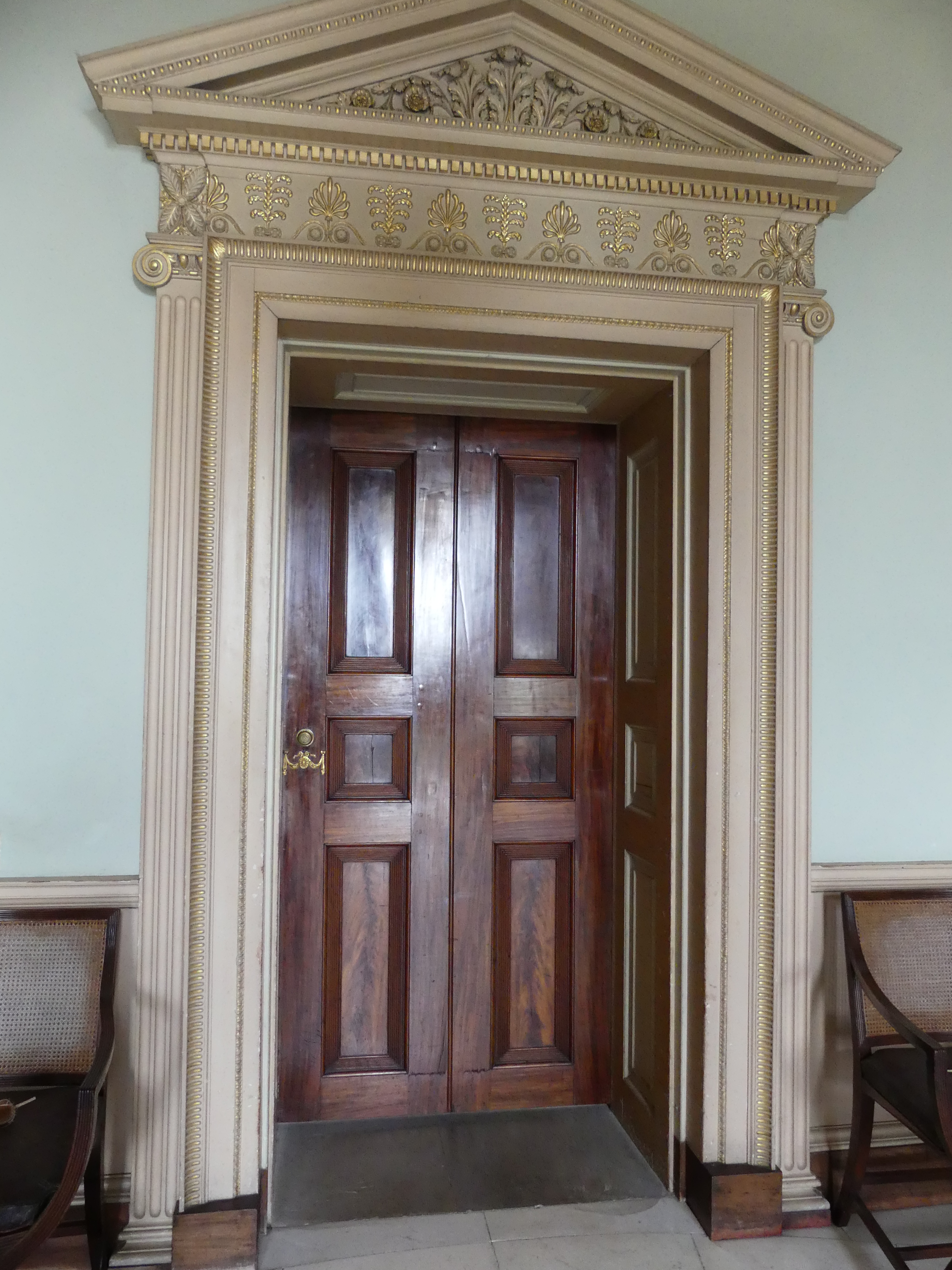
Berrington Hall was built in 1778-81 for a Thomas Harley, son of the 3rd Earl of Oxford.  It was designed by Architect Henry Holland. The interior illustrates his refined Louis XVI style.  There are mythological references to the marriage of Harley's daughter Anne to George the eldest son of Admiral Rodney.


The hall has a grand Ionic portico.


You enter the house via the Marble Hall which was inspired by French neo Classicism introduced to England in  the 1770's by Henry Holland.


Classical plaster roundels of trophies of arms.


Drawing Room


The Boudoir


At this stage I got a bit confused over the rooms! To be honest the house had more visitors than I felt comfortable with and I spent a bit of time dawdling and lingering to try and get away from a huge group who seem to have entered at the same time as me. But as they were reading every bit of information going in the end I decided to continue.


Lady Cawley's Sitting Room


The area around the Staircase Hall and Grand Staircase


The next few rooms were full of exhibits for the "Dress Fit For a King" exhibition of Georgian dresses.  

In 2016 Christie's Auction House contacted the National Trust to say that Ann Harley's Court Mantua which she would have worn to court to meet King George III probably when her husband was Mayor of London 1767/68 was coming up for auction.

Ann Harley was the daughter of Edward Bangham MP and the wife of the Hon. Thomas Harley 1730 - 1804.  The National Trust placed a successful bid and the dress arrived in 10 separate pieces.  The dress was restored throughout 2019.  A section of sleeve was missing and part of the stomacher.  New technology has enable restorers to produce new fabric to replace the missing sleeve


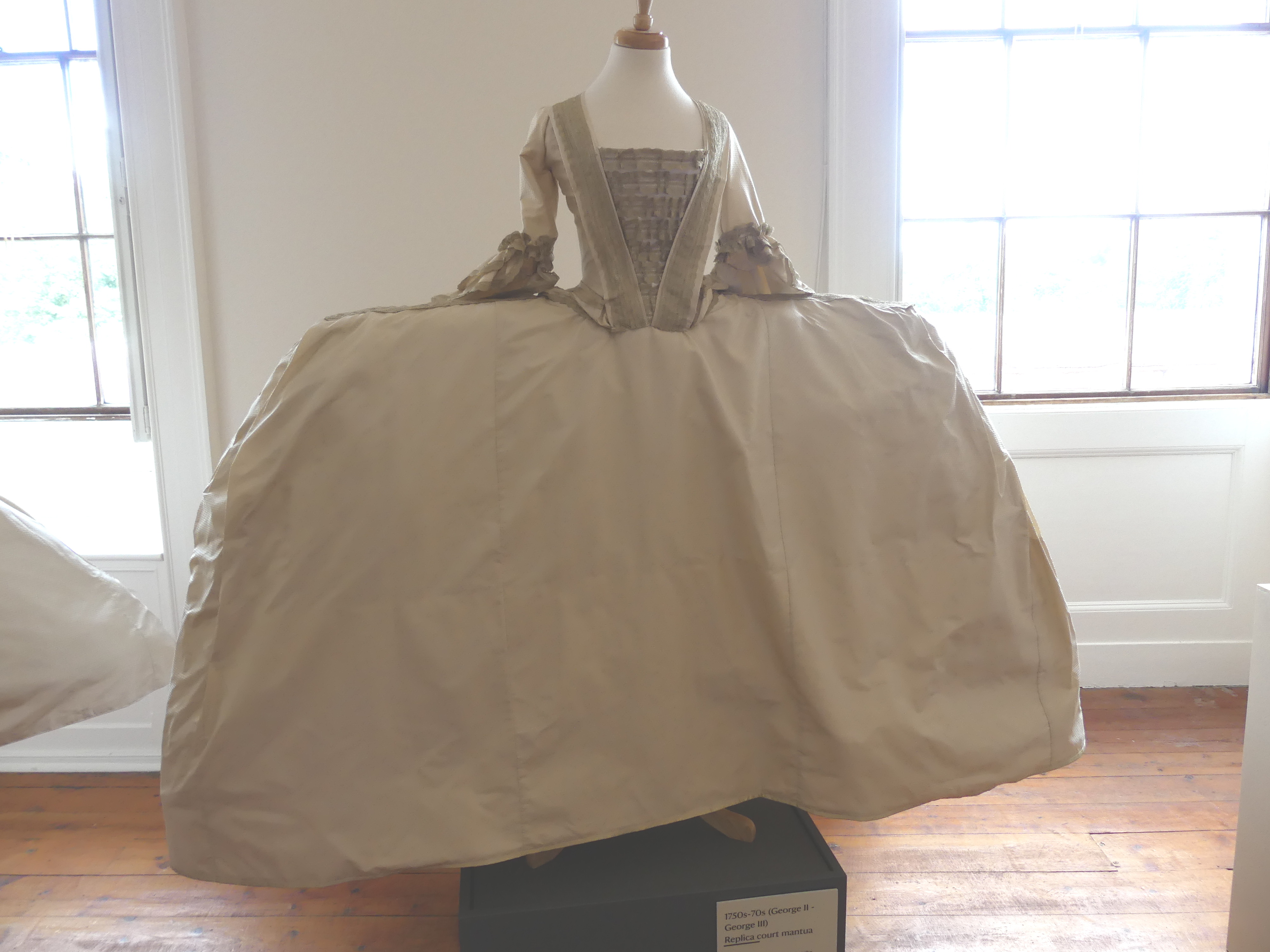
One room contained replica court mantua dresses showing how the dress design changed over the years.

1708/9 (Queen Anne)


1735/40 (George II)


1760's/70's (George III)


Late 1760's (George III)


1750's - 1770's (George II and George III)


And a photo of THE dress I had come to see.


I came out of the exhibition on replica court mantuas to find myself at the top of the servant's stairs so where was THE dress. Somehow I had missed it so I had to retrace my steps to the top of the stairs and ask the guide and there it was hidden away in a room which had been surrounded by people when I arrived hence me missing it!


Isn't it gorgeous?! Although I really would not want to wear it!


The fabric is cream ribbed silk brocade with coloured silk and gold threads. 


Back to the house tour and the Dining Room


I spotted this in the library.


I think some parts of the house were closed ie the Nurseries and the Servants' Quarters.

Leaving the house I met up with B for an icecream and final look at the walled garden.  We later packed and came home in the early evening.

I hope we can return to Herefordshire soon although the ominous news is that the massive rebuilding work in the adjoining semi appears imminent as there are signs they are about to move out.  No sign of any Party Wall Agreement from them though!  I suspect they will just move out and the builders will appear.  I won't go into detail but I am sure you can imagine that I now wish we had made a real effort into moving before all this started although there have been various reasons that have made this difficult which I won't go into here.


I hope everyone is staying safe and well.

All photos taken by me with the Panasonic Lumix FZ330 bridge camera (I don't particularly rate most of my photos but if anyone wises to use one I would be grateful please for an email first).

Reference: National Trust Guide Book to Berrington Hall

National Trust Website Berrington Hall sections