Waxwing

Waxwing
"To see a world in a grain of sand,
And a heaven in a wild flower,
Hold infinity in the palm of your hand
And eternity in an hour."

From "Auguries of Innocence"

by William Blake
Showing posts with label chapels. Show all posts

Saturday, 1 July 2023

Herefordshire 2023 (7) - Part 1: Hatfield and Leominster


On Monday 12th June we returned to Herefordshire for 4 nights.

The Ash "Octopus Tree"  - the octopus and witch's hat shapes have disappeared amongst the leaves.


The Constable Tree


The Herefordshire Oak


Thankfully the plants had survived our absence and the French Marigolds are doing well in a pot as are


the herbs.  The parsley had wilted a bit as had the thyme in a separate pot but both recovered after a good water.  Thankfully, the mint hasn't attracted any Mint Moths.  My son planted a very healthy Apple Mint in a herb pot at home and Mint Moth caterpillars have devastated it :(


We inherited a lovely rose in the garden there and apples are forming although by the time we left there weren't many left a grey squirrel has found them!!!


The owners of the site itself mow the lawns for you and when it is left for a while you get  some lovely wild flowers - Self Heal, Clover, Buttercups, Daisies and Lesser Trefoil. The clover flowers were attracting loads of bumble bees.


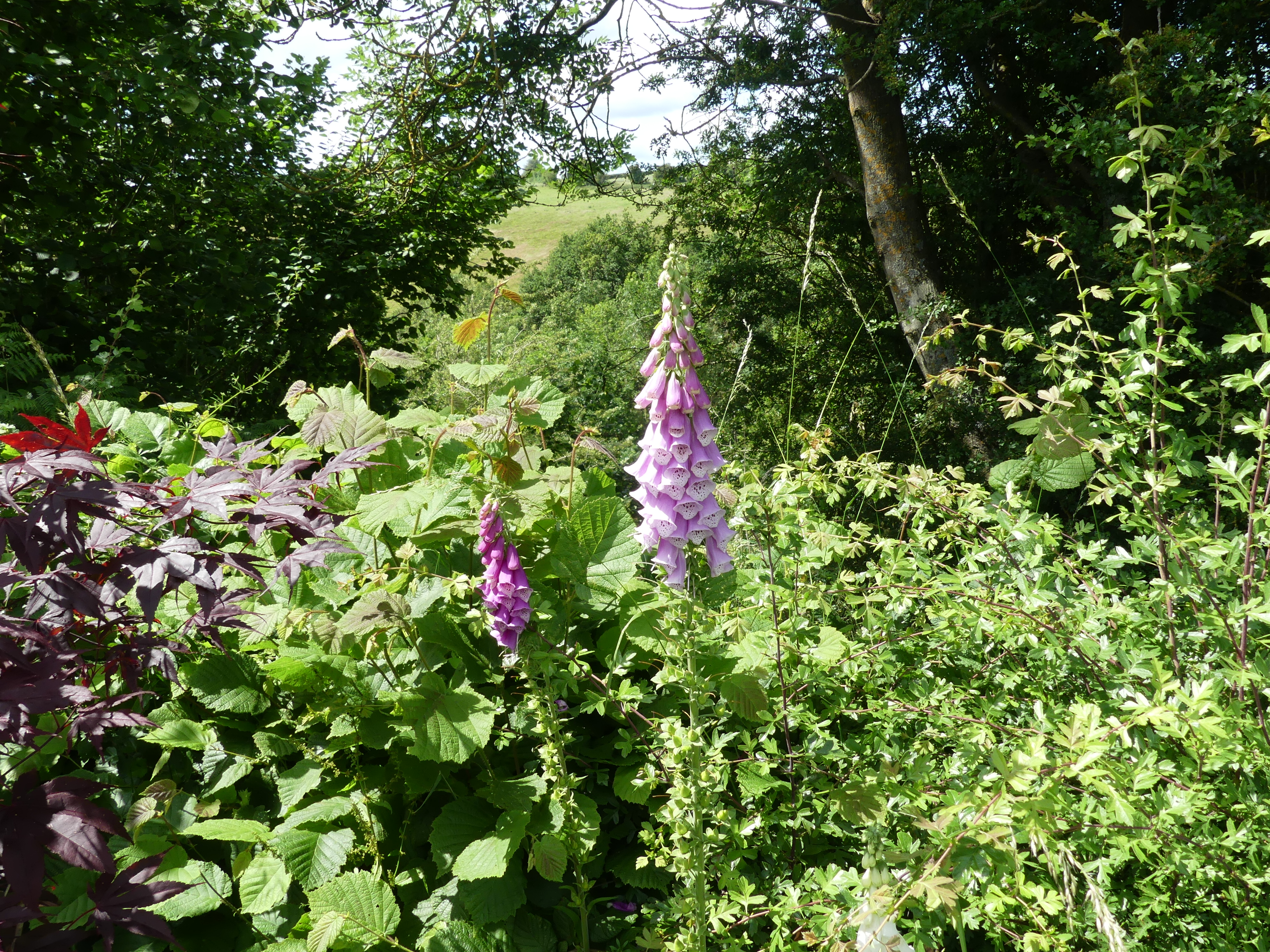
Foxgloves we planted are doing well - there are several white ones as well :)


Timothy back on his shelf!


We used the bat detector several nights and there were several around. D managed this very record shot which is heavily cropped!


*D

*D

My bat detector doesn't tell you the actual species but using information in the Field Studies Council Guide and a process of elimination we think  they are probably Natterer's Bats.  The clues are:

  • Widespread and Common and roost in trees, timber framed barns and stone buildings (there are plenty of those nearby!)

  • Emergence time - 40-60 minutes after sunset which ties in with our sightings.
  • Fast and straight flight at head height along habitat edges which again ties in.
  • Peak Frequency range 49kHz - spot on for our bats
  • Call Frequency Range 20-101kHz which again ties in as I was picking up a call signal throughout that range although obviously fainter at 20 and 101!  This is a useful clue because as far as I can see this is the only bat which has such a large range.The range of Bechstein's Bat is quite large too (28.4-131.0 kHz) but this bat is restricted and rare.
  • I haven't yet tried to work out the call description as I am tone deaf and rubbish with sounds and descriptions!
  • Obviously without a sonogram it is not possible to be 100% sure though.


Monday afternoon we did the usual click and collect at Leominster. Tuesday am it rained and in the end we stayed in all day. I was happy to read and unwind and enjoy the peace and quietness without all the thumping and banging we get at home! Plus I wanted to clean some of the inside of the caravan and it gave me chance to try out the new cheap rechargeable vacuum we bought for there. Its very good and quick - far better than hauling round the old plug in vacuum which these days I find just too heavy to handle.

On the Wednesday we went into Leominster. First port of call was B and Q as B wanted some garden tools for his birthday. You might know they were out of stock!


So we walked along the River Kenwater into Leominster. No Kingfishers or Dippers on the river on this visit but the bramble and other flowers on the river bank had plenty of butterflies and damselflies galore.


Plants in Walls. Ivy Leaved Toadflax in the second photo. I have learnt that Wall Pennywort can be found in Herefordshire so every wall is getting special attention!


Leominster Priory - we'll come back to this in the next post as I finally got the opportunity later for a good look round inside.


This is the West Door with the most amazing carvings by the Herefordshire School of Romanesque Carvers.


The Forbury Chapel


In 1282 the parishioners of Leominster were in conflict with monks at the Priory saying they were being locked out of the parish part of the church. The Priory was visited by John Peckham, Archbishop of Canterbury  and in 1283 he ordered that the Priory should build a chapel for residents of the town to use as a place of worship.This did not suit the ambitious town burgesses and a new nave at the parish church south of the Norman nave was built for the use of parishioners in the town and was consecrated in 1239.

In 1534 Queen Mary I granted a charter to provide for a grammar school in the town and this was located in the chapel until 1795.  It also served as a courthouse.

The chapel was again used for services in 1699 after the Priory roof was destroyed in a fire.  In the 1750's it used as a theatrical school and performances of plays also took part there. This continued for 100 years.  In 1861 it was sold to Thomas Sale a local solicitor who lived in the house next door but used the chapel as his office. There were several private owners in the twentieth cenury the last being a Samuel Beaumont who installed a dance floor and hired the chapel out for parties.

In 1984 it was bought by a trust associated with the priory for community use.


When I walked back later I tried to visit but it seemed locked and, although there was an office in one side of the building I couldn't see anyone to ask if it was possible to view.


I wanted to visit the town centre to take an item back to Rossiters and, as B and D were going to search for garden tools, afterwardsI made my escape back to the Priory which I'll write about in the next post.

After the Priory visit I met up with B and D and we walked back to the car.


*D

Photos taken by me with the Panasonic Lumix FZ330 bridge camera and those marked *D taken by my son with the Canon SX50HS bridge camera. (I don't particularly rate most of my photos but if anyone wishes to use one I would be grateful for an email first - thanks).

Reference: Information Board outside the Forbury Chapel.


Saturday, 6 May 2023

Herefordshire 2023 Visit 2 : - Part 5 Goodrich Castle


Thursday 20th April was cold and windy again but dry and sunny so we took the plunge and finally went to Goodrich Castle down past Ross on Wye.  It was supposed to take about an hour according to Google Maps it took an hour and a quarter but it was well worth the journey time.

Photos D took from the car park.

*D

*D


Goodrich Castle occupies a superb position over the River Wye guarding an important river crossing.  It is one of the best preserved of all English medieval castles.

In 1086 the area belonged to Godric Mappeson and Godric's Castle first mentioned in 1101-2 was presumably built on this site.

Around 1138 the castle was held by Gilbert de Clare and it is thought either he or his son Richard "Strongbow" de Clare (d1176) built the earliest surviving part of the castle - the mid C12th keep.

In 1204 King John gave the castle to William Marshal, Earl of Pembroke, who probably built the lower east curtain wall in the early C13th.


Most of the rest of the castle was built for William de Valence (d1296) who owned the castle following his marriage in 1247.  Most of the rebuilding was probably done between the 1270's and the 1290's.

By 1326 the Talbots had taken over the castle.

The castle was besieged by Parliamentary Forces under Colonel John Birch in 1646 and the powerful mortar he used demolished the NW Tower.

By the late C18th Goodrich had become a tourist attraction for people attracted to the "Picturesque" and the historical association of the castle.

It has been in the care of the Office of Works and then English Heritage since 1920.


*D


*D


The outer defences were built in the late C13 and early C14th. The curtain wall and towers rise above the ditch.


The Gatehouse was built in the late C13th and incorporated all the latest defences.  The modern fixed bridge you cross today to enter the castle was in the C13th a pivoting drawbridge.  A fighting platform was located above so if necessary soldiers could shoot down at the enemy. The gate passage itself had two pairs of wooden gates and 2 portcullises and murder holes.  The gate house also contained residential rooms on the upper floor perhaps for the castle constable.Despite the outer defences the castle was like a country residence inside and used as a centre of local justice and administration.


*D


*D


Roaring Meg was used by Parliamentarian forces to besiege the castle which brought its 500 year old history as a residence to an end.  The Civil War between supporters of  King Charles I and those of Parliamentarians came to Goodrich in 1646.  Sir Henry Lingen, a Royalist held the castle with 120 soldiers and 50 officers under his command.  The Parliamentarian forces under Colonel John Birch were ordered to take Goodrich.  Roaring Meg was built to fire a gunpowder fired shell weighing over 90kg.  The mortar fired in the air with the shell dropping down on the target.  The attacks led to the Royalists surrendering on 31st July 1646.


Chapel and Gatehouse


The Great Hall where feasts were held and it was also the hub of public and administrative life in the castle.  The table of the lord and the most important members of the household was probably located on a dais.


Remains of a bread oven in the kitchen.


Latrine Tower is quite a remarkable feature of the castle and such a large example is rare. It housed a communal latrine used by the whole household.


Entrance to the dungeon


The keep - the oldest part of the castle


B and D went to the top of the keep - photos by D using the Canon - I'd given him my spare camera card.


*D


*D


*D


*D


*D


*D


*D


*D


*D


*D


*D


*D


I in the meantime explored the chapel.It was built in the C13th century for the use of the household which could at times number 200. The Lord and Lady of the Castle would have stood on a gallery.


The Millennium Window designed` by Nicola Hopwood and installed May 2000. The central motif represents the meandering of the River Wye.


Radar Research Squadron Memorial Window was installed in June 1992 to commemorate the staff of the Radar Research Squadron who died while in service when Radar (Radio Detection and Ranging) was being developed.  It features the badge of the RAF and other organsiations who took part in radar research.

On 7th June 1942 a RAF Halifax V9977 caught fire, due to a fuel leak, and crashed 1.5 kms from the castle.  All 11 on board were killed. The plane had been flying on a test mission for the prototyupe H2S radar system.  A Halifax bomber is displayed in part of the window.


We finally left the castle and as we did so B and D spotted some people walking in the ditch. You might know I had already started to go back but B and D went back into the castle and found how to get down to the moat.


D's photos from the moat - tbh I was a bit miffed at missing this.


*D


*D


*D


*D


*D


*D


Goodrich Folklore

Goodrich Castle is haunted by two lovers who died in the Civil War. In 1646 Alice Birch, niece of Colonel Birch the parliamentarian who besieged Goodrich eloped with Charles Clifford and the two lovers were given refuge in the castle by Royalist friends.  While they were there Colonel Birch arrived with his soldiers and mortar and while trying to escape the two lovers drowned in the River Wye.  Their ghosts have been seen trying to cross the river on a phantom horse.


It took ages to get back as we went via Hereford and hit the rush hour.  

Next day Friday we left at lunchtime hoping to miss the traffic. We didn't the M42 seems all roadworks and 50 mph speed restrictions :(


Photos taken by me with the Panasonic Lumix FZ330 bridge camera and those by D taken with the Canon SX50 HS.  If anyone ever wishes to use any of my photos or my son's I would be grateful for an email first  - thanks..


Reference:

Guide Book to Goodrich Castle

Pvsner Buildings of England Herefordshire

Reader's Digest "Folklore, Myths and Legends of Britain"