Waxwing

Waxwing
"To see a world in a grain of sand,
And a heaven in a wild flower,
Hold infinity in the palm of your hand
And eternity in an hour."

From "Auguries of Innocence"

by William Blake
Showing posts with label Chastleton House. Show all posts

Wednesday, 2 November 2016

St Mary's Church, Chastleton and The Four Shires Stone


After visiting Chastleton House and Garden we had a quick look around the Church of St Mary which is next door to the house. It was quite busy in the church as they were serving afternoon tea and cakes (we didn't have any on this occasion :( ).


There may have been a church on the site since before the Norman Conquest but parts of the present building date back to 1100 AD. The church was extended in the early 14th century (1320) and the tower was erected in 1689. The church was restored and the chancel rebuilt by C E Powell in 1878/80.


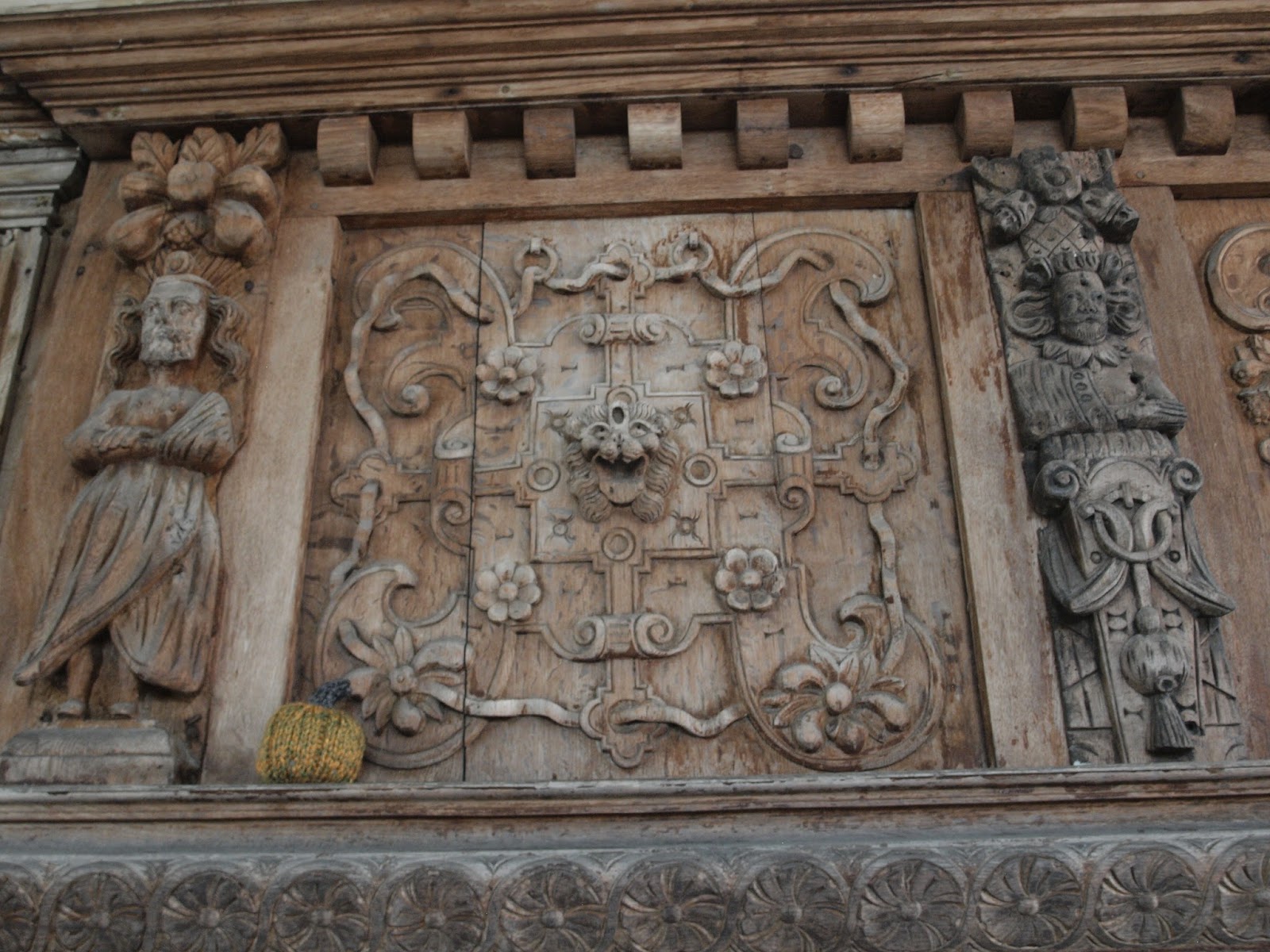
The pulpit is Jacobean and may have been made by the same craftsmen who built most of the panelling in Chastleton House. The date 1623 is carved into the wood.


Fragments of 17th/18th century wall paintings which were discovered in the 1930's.


The stained glass mainly dates back to the 19th century restoration but there are fragments of older, possibly Medieval, glass.


The window of faces


There were a couple of floor brasses (not easy to get photos as it was so dark and I didn't like to use the flash). One is of Katherine Throckmorton, grandmother of Robert Catesby. Robert Catesby lived at Chastleton in 1601 and his name was linked to the Gunpowder Plot of 1605 - he was the son of Anne Throckmorton from Coughton Court. The second brass is of Edmund Ansley who died in 1613.


Annoyingly (and as usual!) I didn't really read the church guide until I got home so I didn't realise that these floor tiles are medieval (14th century). I would have tried to have got better pictures had I realised at the time. I also failed to take a photo of the font which was next to the table serving teas and not easy to access. I later discovered it was 13th century or possibly earlier.


Beautiful lichens covering gravestones.


There is an interesting story in the church guide about a young man called Collins who climbed up onto the gallery in the chancel (the gallery has now been removed) and sprinkled people with pepper as they listened to the sermon. Afterwards he was prosecuted under an ancient Act of Parliament and sent to prison for a few weeks.


Final view of the house


Four Shires Stone

On the way home we stopped off at the Four Shires Stone near Moreton-in-Marsh. It is Grade II listed, 9 feet high, made of Cotswold stone and marks the location where the four counties of Oxfordshire, Warwickshire, Gloucestershire and Worcestershire once met. Today only 3 counties meet here. The stone seen today is 18th century with 19th century lettering although a stone has been at the site since the late 16th century.


Each side of the stone has one of the County names on it.


Many tales have evolved over the centuries suggesting that ancient battles took place nearby and it was once a site for prize fighting and other illegal activities as, if the police arrived, it was easy to move from one county to another! It is also believed that it was the inspiration for J R R Tolkien's Three Farthing Stone which marked a point in the Shire where 3 farthings met.

"Our Warwickshire" website reports that the stone was boarded up in World War 2 to protect it and also so that if the Germans invaded and reached this far inland they would not be able to use it for navigation. For their website please click here It is a fascinating website about the County of Warwickshire and is providing me with lots of ideas for days out :)


I hope to revisit this area one day as I would love to go back to the Rollright Stones and the church at Long Compton nearby has a very unusual and picturesque lychgate.

Sunday, 30 October 2016

Chastleton House and Garden


Last Thursday B and I visited Chastleton House, a Jacobean manor house, and garden in Oxfordshire - a National Trust property we haven't been to before.

Walter Jones had the house built between 1607 and 1612. For various reasons the family struggled to repair the property over the centuries but his descendants lived there until 1991 when the urgent need for repairs led to the house being sold to the National Heritage Memorial Fund who passed it onto the National Trust for management. The National Trust decided to preserve the house rather than restore and it took six years for the house to be made structurally sound.


You walk down to the house from the car park along a path at the side of a sheep field with glorious views of the Oxfordshire countryside.


The dovecote dates from 1762.


I found the approach and entrance to the house delightfully spooky - very apt with Halloween fast approaching!


St Mary's Church


The house was just about to open and there were queues to get in (I had forgotten it was half term!) so we ate the sandwiches we had brought with us in the courtyard and had a look at the guidebook.


We watched a short introductory film on the property and discovered that Chastleton House was used as the location for Wolf Hall and Putney in the 2015 BBC TV adaptation of Hilary Mantel's book "Wolf Hall" which follows the rise of Thomas Cromwell in the Tudor Court from his lowly beginnings as a blacksmith's son. A cast of 125 actors and a crew of 75 were involved in the filming. Other NT properties used were Montacute House and Barrington Court (Somerset) and Lacock Abbey and Great Chalfield Manor (Wiltshire).


The inevitable Ivy-leaved Toadflax growing up a wall


and a mosaic of tree bark.


The house still looked busy so we had a quick look round the garden first. Seventeenth century walls divided the garden into a series of "rooms". The layout is Jacobean and is a rare survival from an era when gardens were created to show man's mastery over nature! Today the National Trust are in the process of restoring the garden.


Looking towards the croquet lawn with the Wilderness behind. Walter Jones-Whitmore in the Nineteenth Century became known as the "Father of Croquet" and he created the game on the lawns of Chastleton House. He won the first national croquet championships. He was also well known for other inventions - a "clockwork bootlace winder" and an "explosive bell pull" system on trains which stopped them in an emergency.


The Kitchen Garden


The Best Garden - a Jacobean Pleasure Garden consisting of yew and box topiary.


And onwards into the house. You can visit a lot of rooms - parlours, lobby, bedrooms, the Great Chamber, library, museum room, the Long Gallery and the old kitchen but it was very dark in many of the rooms (probably the darkest of any NT property I have visited). No wonder they filmed Wolf Hall here as I seem to remember quite a few of the scenes in the series were very poorly lit! Consequently I couldn't get many photos and the one's I did take were poor - oh, to have a camera that performs well in low light!

Entering the house


19th century stained glass windows in the Great Parlour depicting Charles I and Henrietta Maria


Dining Table (blurred!)


The Fettiplace Room - the tapestry to the left is 17th century and shows the Story of Jacob - the bedcovers date from 1720 -1730


Lovely wooden carvings on the bed in The Cavalier Room. Following the Battle of Worcester in 1651, the owner of Chastleton House (Arthur Jones - "the Cavalier" and supporter of Charles II) fled the battlefield and was hiding in a closet adjoining this room when a group of Parliamentary soldiers arrived at the house demanding a room for the night. Arthur's wife, Sarah, gave Cromwell's soldiers a flagon of ale to which she had added laudanum allowing her husband to escape while the soldiers slept.


The Long Gallery (which is superb) runs the whole length of the North front (a distance of 22 metres) and is the longest surviving barrel-vaulted ceiling of its date in England. This type of room was a status symbol and was used to display ancestral portraits, for the occasional indoor stroll when weather was inclement and in the 19th century badminton was played here. The plaster work was restored 1904/5.


At the West end of the Long Gallery the spandrels have unique painted masks in a Japanese style. The design is so unusual that it is believed they were part of the original scheme and thus very rare. Due to their location either side of the window it is thought they are a type of apotropaic mask (a modified Green Man) placed there to stop evil spirits entering the house. Matching masks may once have also been placed at the East end windows.


We paid a brief visit to the Church before leaving to search for the Four Shire Stone but I will leave that for another post.