
On Monday 12th June we returned to Herefordshire for 4 nights.
The Ash "Octopus Tree" - the octopus and witch's hat shapes have disappeared amongst the leaves.

The Constable Tree

The Herefordshire Oak

Thankfully the plants had survived our absence and the French Marigolds are doing well in a pot as are

the herbs. The parsley had wilted a bit as had the thyme in a separate pot but both recovered after a good water. Thankfully, the mint hasn't attracted any Mint Moths. My son planted a very healthy Apple Mint in a herb pot at home and Mint Moth caterpillars have devastated it :(

We inherited a lovely rose in the garden there and apples are forming although by the time we left there weren't many left a grey squirrel has found them!!!


The owners of the site itself mow the lawns for you and when it is left for a while you get some lovely wild flowers - Self Heal, Clover, Buttercups, Daisies and Lesser Trefoil. The clover flowers were attracting loads of bumble bees.


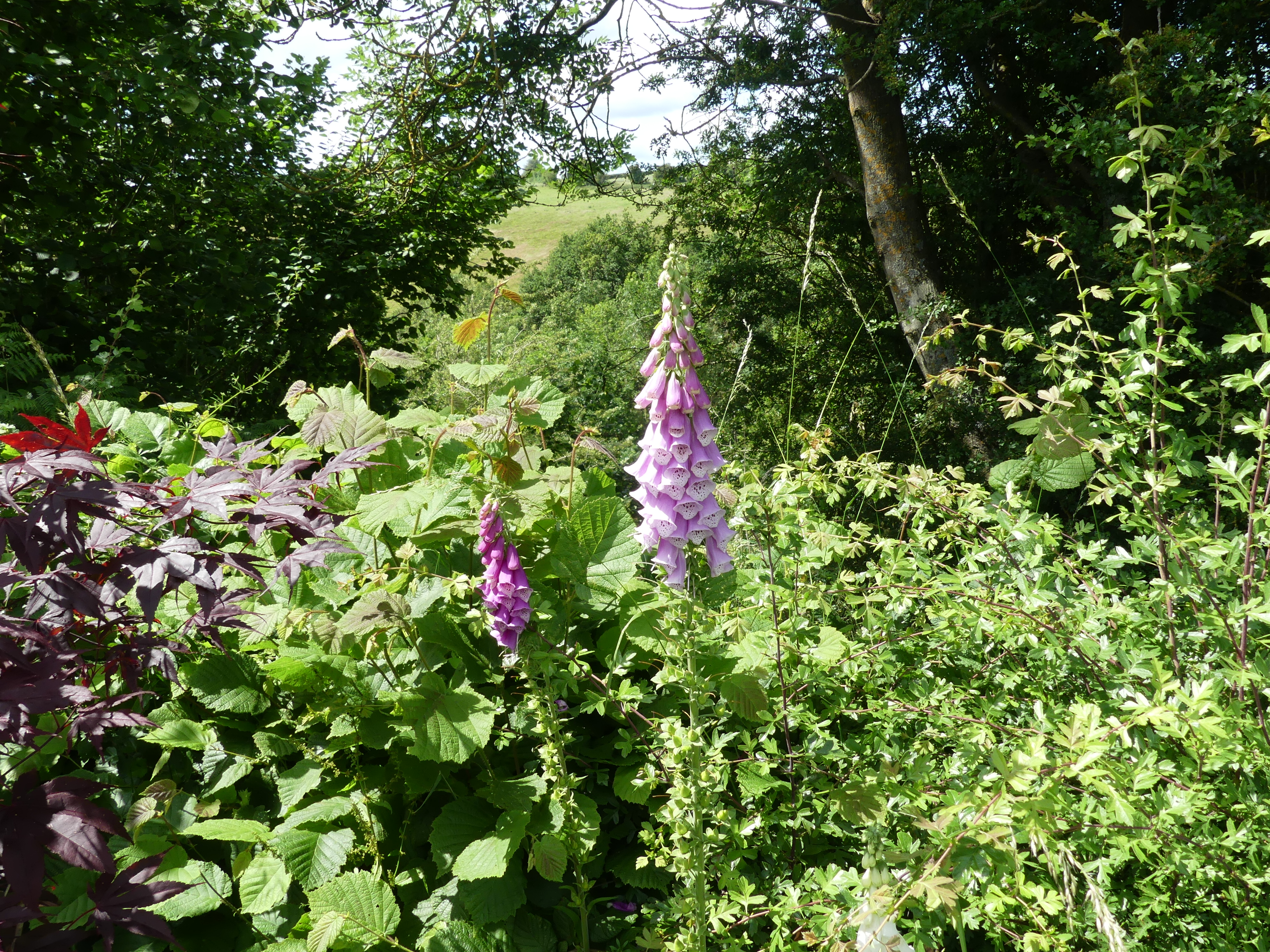
Foxgloves we planted are doing well - there are several white ones as well :)
Timothy back on his shelf!

We used the bat detector several nights and there were several around. D managed this very record shot which is heavily cropped!


My bat detector doesn't tell you the actual species but using information in the Field Studies Council Guide and a process of elimination we think they are probably Natterer's Bats. The clues are:
- Widespread and Common and roost in trees, timber framed barns and stone buildings (there are plenty of those nearby!)
- Emergence time - 40-60 minutes after sunset which ties in with our sightings.
- Fast and straight flight at head height along habitat edges which again ties in.
- Peak Frequency range 49kHz - spot on for our bats
- Call Frequency Range 20-101kHz which again ties in as I was picking up a call signal throughout that range although obviously fainter at 20 and 101! This is a useful clue because as far as I can see this is the only bat which has such a large range.The range of Bechstein's Bat is quite large too (28.4-131.0 kHz) but this bat is restricted and rare.
- I haven't yet tried to work out the call description as I am tone deaf and rubbish with sounds and descriptions!
- Obviously without a sonogram it is not possible to be 100% sure though.
Monday afternoon we did the usual click and collect at Leominster. Tuesday am it rained and in the end we stayed in all day. I was happy to read and unwind and enjoy the peace and quietness without all the thumping and banging we get at home! Plus I wanted to clean some of the inside of the caravan and it gave me chance to try out the new cheap rechargeable vacuum we bought for there. Its very good and quick - far better than hauling round the old plug in vacuum which these days I find just too heavy to handle.
On the Wednesday we went into Leominster. First port of call was B and Q as B wanted some garden tools for his birthday. You might know they were out of stock!


So we walked along the River Kenwater into Leominster. No Kingfishers or Dippers on the river on this visit but the bramble and other flowers on the river bank had plenty of butterflies and damselflies galore.


Plants in Walls. Ivy Leaved Toadflax in the second photo. I have learnt that Wall Pennywort can be found in Herefordshire so every wall is getting special attention!


Leominster Priory - we'll come back to this in the next post as I finally got the opportunity later for a good look round inside.

This is the West Door with the most amazing carvings by the Herefordshire School of Romanesque Carvers.


The Forbury Chapel

In 1282 the parishioners of Leominster were in conflict with monks at the Priory saying they were being locked out of the parish part of the church. The Priory was visited by John Peckham, Archbishop of Canterbury and in 1283 he ordered that the Priory should build a chapel for residents of the town to use as a place of worship.This did not suit the ambitious town burgesses and a new nave at the parish church south of the Norman nave was built for the use of parishioners in the town and was consecrated in 1239.
In 1534 Queen Mary I granted a charter to provide for a grammar school in the town and this was located in the chapel until 1795. It also served as a courthouse.
The chapel was again used for services in 1699 after the Priory roof was destroyed in a fire. In the 1750's it used as a theatrical school and performances of plays also took part there. This continued for 100 years. In 1861 it was sold to Thomas Sale a local solicitor who lived in the house next door but used the chapel as his office. There were several private owners in the twentieth cenury the last being a Samuel Beaumont who installed a dance floor and hired the chapel out for parties.
In 1984 it was bought by a trust associated with the priory for community use.


When I walked back later I tried to visit but it seemed locked and, although there was an office in one side of the building I couldn't see anyone to ask if it was possible to view.


I wanted to visit the town centre to take an item back to Rossiters and, as B and D were going to search for garden tools, afterwardsI made my escape back to the Priory which I'll write about in the next post.
After the Priory visit I met up with B and D and we walked back to the car.


Photos taken by me with the Panasonic Lumix FZ330 bridge camera and those marked *D taken by my son with the Canon SX50HS bridge camera. (I don't particularly rate most of my photos but if anyone wishes to use one I would be grateful for an email first - thanks).
Reference: Information Board outside the Forbury Chapel.


