Waxwing

Waxwing
"To see a world in a grain of sand,
And a heaven in a wild flower,
Hold infinity in the palm of your hand
And eternity in an hour."

From "Auguries of Innocence"

by William Blake

Saturday, 21 July 2012

Mini Wildflower Meadow


The wildflower meadow in the garden is probably looking its best now. Regular visitors to this blog may recall that one third of the mini meadow was re-seeded earlier in the year after being dug over to remove the couch grass that was beginning to dominate.

Poppies are the main flower in the newly re-seeded area although this will change over the years as other species establish themselves.


St John's Wort and Poppies


Field Scabious


You can just make out cornflower and corn marigold behind the poppies


St Johns Wort and Lesser Knapweed are the main species in the "older" part of the meadow now that Red Campion has in the main finished flowering


Yarrow


In flower at the moment in the garden "meadow" are St John's Wort, Poppy, Ox-eye Daisy, Cornflower, Corn Marigold, Field Scabious, Lesser Knapweed, Meadow Buttercup, Salad Burnet, Field Pansy, Yarrow, Red Campion, Common Vetch and Trefoil. There were several hoverflies and bumble bees amongst the flowers this morning and hopefully as summer finally arrives over the next few days and we get some sunshine their numbers should increase.


Thursday, 19 July 2012

More New Moth Species for the Garden

Sunday night's moth trapping session produced a few nice surprises on Monday morning including several new garden "ticks". Not too many micros to identify as I tend to pot the macros first resulting in many of the micros escaping.

Despite looking distinctive the first moth took me a long time to identify. I am pretty sure it is Shaded Broad-bar (Scotopteryx chenopodiata) a new species for the garden. The photos aren't brilliant but it was rather lively!


This by the way is a species of conservation concern under the UK Biodiversity Action Plan (BAP)


As mentioned in yesterday's post this beautiful Peppered Moth - another new garden species.


Scalloped Oak


Single-dotted Wave - New for year


Flame - New for Year


I think this is another Garden Grass-veneer

Edit - Many thanks to David Shenton for confirming this species


I thought at first the next species was a worn carpet but on checking the moth "bible" and various websites I now think it is July Flyer which would be another garden "tick"

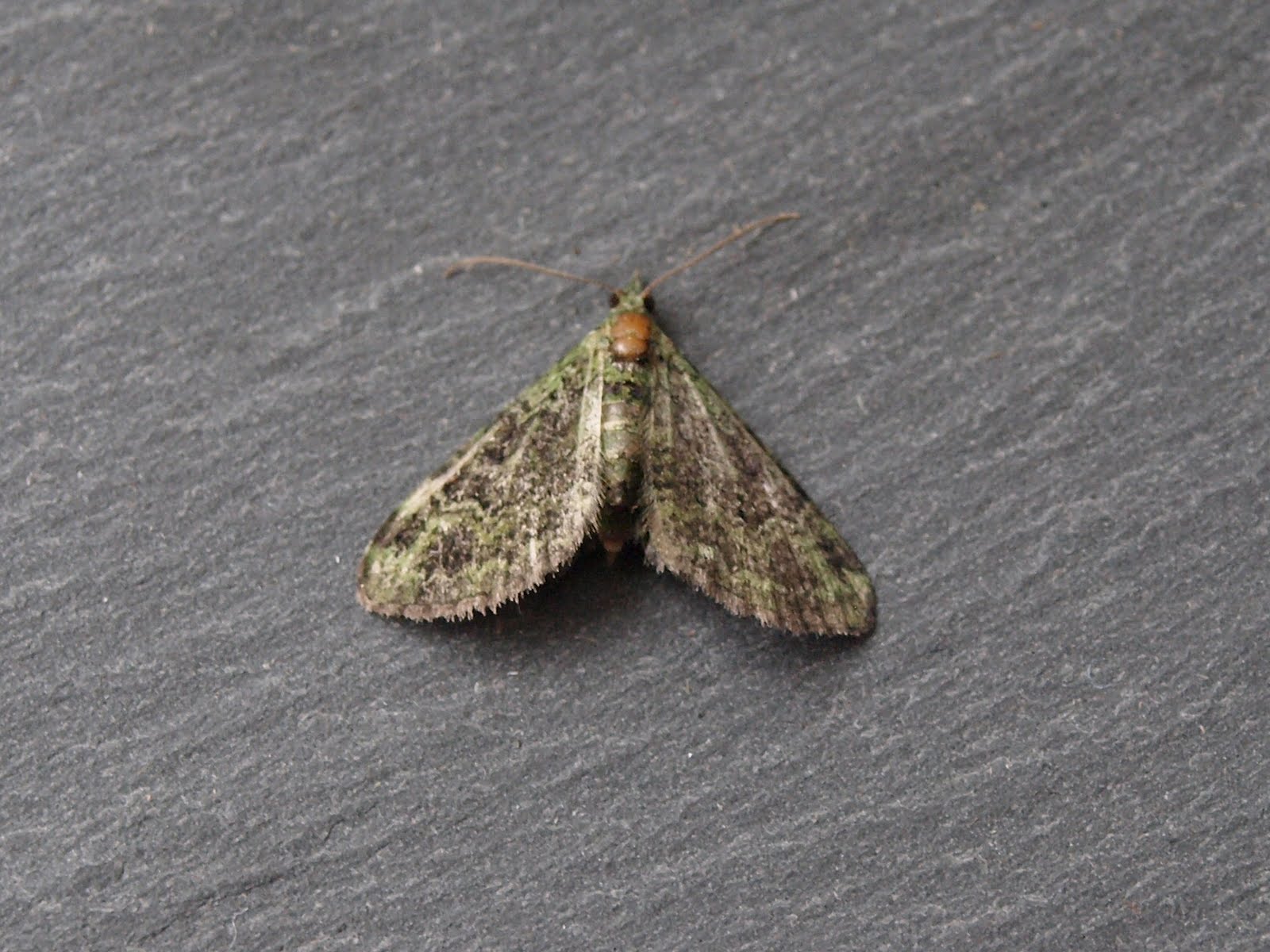
Edit - Thanks again to David Shenton for letting me know this is a Green Pug (sadly not a new garden tick but a new species for the year)


I haven't a clue which species this micro is - sorry very blurred photos it was very very lively.

Edit Many thanks again to David - this is a Juniper Webber (Dichomeris marginella)


And two species (the first a carpet and the second one of the noctuids) which are so worn I haven't attempted to identify these. But it does illustrate some of the id problems I have with moths especially as I often struggle with even the well-marked individuals!


As always if any of the above identifications are incorrect please let me know and I would be especially grateful if anyone could confirm my identifications of Shaded Broad-bar and July Flyer.

Summary of Moths Trapped Sunday, 15th July

Minimum Temperature 11.3 degrees Centigrade

15w Actinic Skinner Trap

9.30 till dawn

2381 Uncertain (Hoplodrina alsines) x 24

2382 Rustic (Hoplodrina blanda) x 2

2089 Heart and Dart (Agrotis exclamationis) x 4

2321 Dark Arches (Apamea monoglypha) x 8

1304 Agriphila straminella x 1

2098 Flame (Axylia putris) x 3 New for Year

1713 Riband Wave (Idaea aversata) x 2

1921 Scalloped Oak (Crocallis elinguaria) x 2

1708 Single-dotted Wave (Idaea dimidiata) x 1 New for Year

1524 Emmelina monodactyla x 1

1931 Peppered Moth (Biston betularia) x 1 New for Garden

1293 Garden Grass-veneer (Chrysoteuchia culmella) x 2

1732 Shaded Broad-bar (Scototeryx chenopodiata) x 1 New for Garden

July Flyer x 1 (would be new for garden if confirmed)??
Edit Green Pug x 1 (New for Year) not July Flyer

plus

Juniper Webber (Dichomeris marginella) x 1 NFG

Wednesday, 18 July 2012

Peppered Moths - An example of Natural Selection in Action


Peppered Moth - the pale "typica" form


I was really rather pleased to trap a Peppered Moth (Biston betularia) in my trap on Monday morning as not only is this a beautiful looking moth but it has a fascinating story to tell.

This species is a classic example of evolution by natural selection. Prior to the Industrial Revolution the light coloured ("typica") form of the moth as shown in the photo above was predominant. Its light coloured, peppery marked wings provided perfect camouflage against lichen covered tree bark.

Following the Industrial Revolution a dark, melanic ("carbonaria") form was first recorded in Manchester in 1848. Within 60 years 98 per cent of the moth population of the Peppered Moth in the heavily polluted industrial city of Manchester in Northern England was of this form whereas the the Peppered Moths found in woodland in areas free of air pollution retained the pale "typica" form.

In a classic series of experiments the British ecologist H B D Kettlewell demonstrated that the key factor behind the different forms was differential predation by birds.

In industrialised areas the "typica" light form of the moth was not well camouflaged against tree bark blackened by soot and, therefore, it was found more quickly and heavily predated by birds. However, the black, melanic "carbonaria" form which was well camouflaged was found and eaten far less.

In woodlands in unpolluted areas the situation was reversed. Here the pale "typica" form of the moth was perfectly camouflaged on a background of lichen encrusted tree bark and thus not heavily predated whereas the dark "carbonaria" form stood out like a sore thumb and was easily found and eaten by birds.

Since the Clean Air Act of 1964 was introduced and the subsequent decline in manufacturing industries, air pollution has fallen. The moth has responded very quickly to this change and the dark melanic form has declined considerably.

In 1998 Majerus in "Melanism - Evolution in Action" pointed out various flaws in Kettlewell's experiments.

Today, further studies are being undertaken to investigate the role that natural selection together with predation by birds played in the rise and subsequent fall of the dark melanic form and so the Peppered Moth Story is incomplete rather than wrong.

Currently changes in the colour of the Peppered Moth are still seen as an example of natural selection in action but predation by birds is just one driving factor amongst others rather than bird predation being the sole factor as suggested by Kettlewell.


References:

"Enjoying Moths" by Roy Leverton

The Peppered Moth - an Update website
www.millerandlevine.com/km/evol/Moths/moths.html

Monday, 16 July 2012

Please help save our Badgers

The Badger Trust's legal bid to block badger culling in England very sadly failed last week in the High Court.

Culling may, therefore, now go ahead in West Gloucestershire and West Somerset later this year.

The RSPCA has launched a "Don't Shoot - Take action for badgers facing a cull" campaign. The RSPCA believes that vaccination, increased levels of testing and improved biosecurity measures are more effective ways of dealing with the problem in the long term.

DEFRA has made u-turns before in the face of public outrage such as over the sale of forests and, more recently, over their proposed "research" programme into dealing with buzzards who "threatened" young pheasants.

So, if you feel as strongly opposed to the proposed badger cull, as I do please visit the RSPCA's website :

www.rspca.org.uk/getinvolved/campaigns/wildlife/badgers/takeaction

and send an email to Caroline Spelman - it will only take a minute of your time and, if enough people bombard her perhaps it will save the lives of many thousands of badgers most of which will be disease free.

Many thanks.

Sunday, 15 July 2012

Dragonfly Exuvia


Whilst exacavating the rockery to put in the waterfall this morning Brian found a dragonfly exuvia floating in the pond.


Dragonfly and damselfly nymphs live in water feeding on animals such as waterfleas, insect larvae and even tadpoles and small fish. They go through a series of moults and complete their development in one or two years although it can take up to five years for larger species. When development is complete they climb stems and leaves of bankside plants at night or early in the morning during late spring or summer. The adult will then emerge over the course of several hours. I have found exuvia (cast-off skins) on plants by our pond before but never been lucky enough to see an adult emerging.

Due to the well developed wing buds I am pretty sure a dragonfly emerged (you can see the exit hole behind the head) from this exuvia rather than it just being a cast-off skin from one of the nymph's moults.


The exuvia was around 45 millimetres long and around 5 millimetres wide.


The shape of the large eyes being almost half the length of the head with an angled rear edge, together with the size of the exuvia, suggest that this may be the exuvia of one of the Aeshna hawker dragonflies.


Unfortunately by the time I had found a dragonfly id guide after taking the first lot of photos and realised it was important to take a photo of the underside of the head and mouthparts to work out the type of labium, the exuvia had fallen off the barbecue and was now in two parts - so a very blurred picture of underside of the head.


My dragonfly identification skills are not particularly good and this is the first time I have attempted to identify which species may have emerged from an exuvia so if anyone can enlighten me more on which species this may be please leave a comment.

Edit - Apologies for the strange appearance of this post - whilst checking it in Preview half the typing seems to be in blue (no idea why!!).

Reference

FSC Guide to dragonflies and damselflies of Britain

WildGuides - Britain's Dragonflies by David Smallshire and Andy Swash published by English Nature

Friday, 13 July 2012

Following in the Footsteps of an "Edwardian Lady" - Part 5 : Packwood House Gardens


Between 1880 and 1890 Edith Holden lived with her family at a house called Troutbeck in Darley Green. Packwood House was just a short walk away and the Holden children knew the Oakes family who lived at Packwood at the time and the Holdens often visited the gardens. Edith and her mother and sisters also often walked through Packwood House Park. Edith often mentioned visiting the Packwood area in "The Country Diary of an Edwardian Lady" and "Nature Notes".

On the 7th July, 1906, she writes in The Country Diary that she was given a beautiful white water lily from the pool at Packwood House. There are several paintings of water lilies both white and yellow for the month of July in this book.

I decided to go along to Packwood House Gardens one afternoon last week to see if water lilies were still to be found.

Walking out of the car park the North Court can be seen.


Entrance to the House and Gardens


Flower borders surround the courtyard by the Reception and Shop


Entrance to the House


Entrance to the Carolean Garden


Garden Pond in the Sunken Garden with the Yew Garden in the distance


There were water lilies in this pool although pink rather than white!


There is a much larger pool in the parkland outside the walled garden and it could be that the water lily given to Edith came from this pool. I couldn't see any sign of water lilies and did plan to walk round to see if I could find any but, although I had left home in sunshine, by the time I arrived it had clouded over and rain was threatening in typical Summer 2012 fashion!!


I did manage at long last to find some Meadowsweet in flower as this species is often mentioned by Edith on her travels in June and July.


The Gardens and fish ponds at Packwood fascinated Edith as did the Yew Garden which is said to represent the Sermon on the Mount. She spent time here sketching accompanied by the sound of birds and hum of bees from the hives.


The Gardens at Packwood were looking particularly beautiful despite the lack of sunshine. This is the Yellow Border although there are flowers of other colours mixed in with the yellow blooms


Back in the Sunken Garden


The borders surrounding the pool were redeveloped in 2007 resulting in an exotic garden theme.


Borders leading up to the Raised Terrace Walk with the Yew Garden behind


Bays full of roses


The Raised Terrace Walk - probably my favourite part of the Garden


On my way out I bought one of these Rudbekia plants from the shop to plant in our herbaceous border at home.


Three quarters of an hour after my arrival the rain arrived! So I gave up plans to walk around the yew garden and parkland and sheltered for a while in a gazebo.

Rose Garden from the Gazebo


Sunken Garden with the house behind


A few photos of some of the sundials scattered around the House and Gardens


Leaving the Gardens


As a matter of interest "Richard II" recently shown as part of BBC Two's Shakespeare season was partly filmed at Packwood House and Gardens.

Reference:

Country Diary of an Edwardian Lady by Edith Holden
The Country Diary Companion by Josephine Pool
The Edwardian Lady - The Story of Edith Holden Compiled by Ina Taylor