Waxwing

Waxwing
"To see a world in a grain of sand,
And a heaven in a wild flower,
Hold infinity in the palm of your hand
And eternity in an hour."

From "Auguries of Innocence"

by William Blake

Friday, 9 March 2012

Packwood House


I paid a brief visit to Packwood House at the end of last week and finally got round to sorting out the photos today. (My mum finally came out of hospital a few weeks ago but sadly her condition (she has Alzheimer's) has deteriorated rapidly since Christmas and there's a lot of sorting out to be done about her long-time care and decisions to be made - so life has been rather hectic recently.)

A photo of one of the sundials which are to be found on buildings at Packwood


Various species of hellebore were putting on a lovely show


Euphorbia


Twisted wisteria branches on the walls of the house


I don't remember seeing this tin bath before - it will be interesting to see if it becomes a feature somewhere around the grounds


A plaque of the Green Man


The Seventeenth Century Yew Garden is believed to represent "The Sermon on the Mount"


The Carolean Garden


There's a lovely display of snowdrops at the side of the house in a meadow but unfortunately part of the gardens and grounds are still closed so it was only viewable from the lane


I popped into the Kitchen Garden before I left and found this Dipping Pool. Apparently Dipping Pools have been a feature of gardens since the 14th/15th century and were used for watering garden plots. Although more ornate shapes were made, a typical pool was round and shallow and usually placed at the centre of the garden. This particular pool at Packwood has been based on evidence from an old garden plan and has been constructed using recycled bricks from the estate.


Edith Holden regularly visited Packwood House gardens and grounds but I will do a "Following in the Footsteps..." post later in the year to tie in with her mention of Packwood in the Country Diary.

Finally, a photo of some lambs I spotted in a Warwickshire field yesterday - the first I've seen this year although these look several weeks old.

Tuesday, 6 March 2012

Robins Galore at Brandon Marsh NR


At lunchtime yesterday I headed over to Brandon Marsh NR - my first visit this year. Brandon Marsh, situated to the east of Coventry, is the headquarters of Warwickshire Wildlife Trust and a flagship reserve. It consists of a mixture of habitats - pools, reedbeds, grassland and scrub, mature woodland and wet woodland and willow scrub. I spent a couple of hours at the reserve - although it was sunny and spring-like there was a very cold wind and I was glad of my gloves.


After walking from the Visitor Centre through Hope Wood, I made my way to Horsetail Glade first of all. This is often a good place to see Lesser Spotted Woodpecker but I wasn't lucky today and, in fact, I haven't read of any sightings yet this year. There were lots of blue and great tits and a few long-tailed tits about.

Part of Horsetail Glade


As I walked through woodland along one side of Goose Pool there were loads of tame robins about - many singing away, like the one in the photo below, to establish territories.


This particular individual was the tamest of them all


A view of part of Goose Pool


As I walked past Primrose Bank there were several primrose plants coming into flower.

Normally Jon Baldwin hide is very quiet and its where I usually manage to get some photos of duck species as they approach the hide closely but today it was heaving with photographers taking pictures of the goldeneye (both male and female were present). My 70 - 300 telephoto couldn't compete with the massive 500 mm lenses on show but here's a record shot of the drake!


Oystercatchers have recently started to arrive back at the reserve and one flew onto a nearby island but the real highlight for me was a kingfisher skimming low over the water with the irridiscent blue colouring gleaming in the sunlight. There were a pair of great crested grebes about but I didn't see any sign of courtship displays.

I carried on to the East Marsh Hide - here's a view of part of East Marsh Pool from the hide


and was thrilled to see the drake pintail (a male and female have been present for at least a week) - a new year tick and a new species for my Brandon Marsh list. Too far away again to photo so another record shot


There wasn't much to see from Carlton Hide which overlooks the Newland Reedbeds so I retraced my route


and came across yet more tame robins. I believe lots of people take food and mealworms - you don't really need a telephoto lens to take photos. I quite like these shots even though there were twigs in the way!


I love the way the robin is puffing out his chest here in a territorial display either at me or more likely yet another tame robin just behind me!


I just had time to walk around the back of Grebe Pool before returning to the visitor centre spotting a pair of bullfinches. There were lots of grey squirrels


and rabbits about.


Following the reintroduction of water voles to the reserve late last summer I did keep my eyes open - but no sign of any today.

Twenty eight species wasn't a bad total for a couple of hours and kingfisher, cormorant, goldeneye,oystercatcher, shelduck, pochard, pintail and lesser black-backed gull were all new species for the year.

Finally, a photo of a row of cute recycling frog bins that line one side of the courtyard at the visitors centre.

Saturday, 3 March 2012

GMS Begins

The first trapping session for the Garden Moth Scheme last night.

I trapped four moths of four species.

Dotted Border (New for Year)
A Geometrid and this one is a male as the females are flightless. This species overwinters as a pupa.


Satellite (a Noctuid) (New for Year and New for Garden)
I've wanted to trap one of these for ages - so named because of the two small satellites close to the stigmata


March Moth (New for Year and New for Garden)
Another member of the Geometridae family - again a male as females are flightless


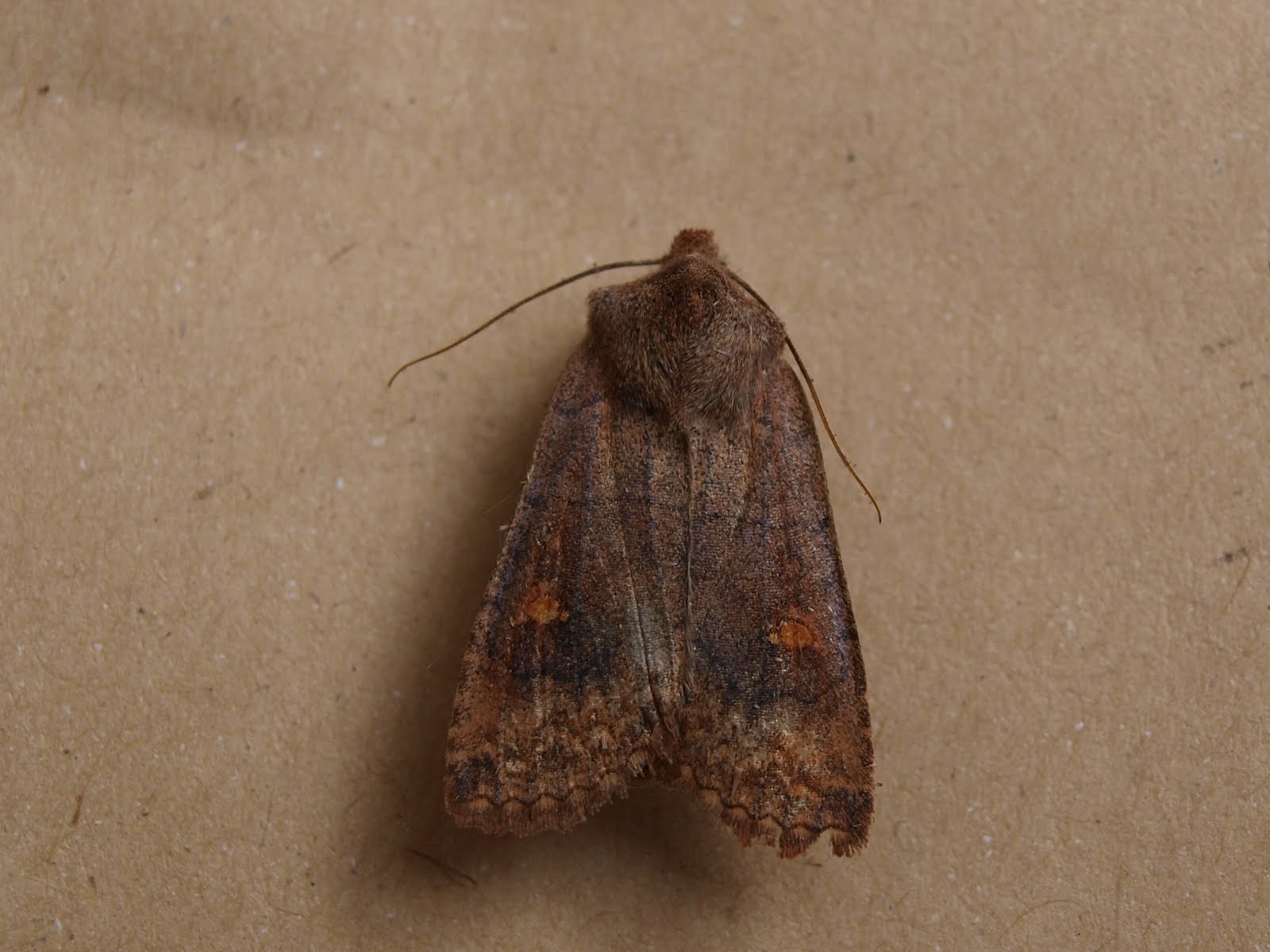
And now we have a lbj of the moth world - id headaches have started early this year with a worn brown noctuid! My best guess for this one is a Dark Chestnut but I am probably hopelessly wrong!


Summary of Moths Trapped Friday, 2nd March

15w Actinic Skinner Trap

Minimum Temperature 5.6 degrees centigrade

1934 Dotted Border (Agriopsis marginaria) x 1

1663 March Moth (Alsophila aescularia) x 1

2256 Satellite (Eupsilia transversa) x 1

plus possible Dark Chestnut???

Edit - many thanks to Dean (from ddd please see link on the right) for identifying this moth as a Chestnut (new species for year and new for garden too!)

As always please feel free to correct any wrong id and any help with the mystery moth would be very appreciated! Sorry about lack of italics for the scientific latin names for some reason I can never get the blogger italics to work.


Garden moth species for 2012 = 4 Edit 5

Garden Moth Species since 2009 = 135 Edit 136


Garden Update

I saw my first garden buff-tailed bumble bee yesterday nectaring on winter flowering pansies and last weekend we turned on the camera in the nest box to watch a blue tit pecking around and taking away any loose pieces of wood it could find. Still no sign of frogspawn.

And I've made a start on making the garden more bee and insect friendly buying cosmos, sunflower, candytuft,nasturtium and night-scented stock seeds and a packet of mixed bumble bee friendly flower seeds. Whilst at the nurseries I also bought an Oriental Poppy with a bee friendly plant sticker on it - good to see Sarah Raven's campaign is working!

Thursday, 1 March 2012

St Giles, Packwood

Following on from my previous post on Edith Holden's journey to Packwood Hall and Church - here's a bit more information on St Giles Church, which is over 800 years old, and more photos.

The first church on the site was probably wooden and was replaced by the present stone nave and chancel in the late thirteenth century. Nearby Packwood Hall, now privately owned, was, it is thought, once a residence of priests from Coventry Priory Cathedral.

In June 1706 Michael Johnson, a bookseller from Lichfield married Sara Ford from Packwood in the church. Their son born in 1709 grew up to be Dr Samuel Johnson of literary fame.


The church tower, known as The Tower of Atonement, was added in the late fifteenth century by Nicholas Brome, Lord of nearby Baddesley Clinton, as an act of atonement for murdering a local priest who he found his parlour "chockings his wife under ye chinne" (Ferrars).


These pilgrim marks scratched in stone underneath the windows near the altar were made by pilgrims leaving their mark when visiting the church in the past - in the same way we might sign a visitors' book today.


Original pews once situated around the side of the church


The wall paintings shown in the photos below have been dated to the fourteenth century and are known as Packwood's Doom Painting. They were concealed by plaster during the Protestant Reformation and were only revealed again in 1927. They represent the Day of Judgement.


The font could be as old as the church and at one time disappeared - only to be found being used locally as an animal trough. The lack of engravings signify that the church had little revenue.


This ancient chest is believed to be Norman and could be older than the church. It was hewn from a tree trunk. It was once used to keep parish records and has 3 locks which could only be opened when the priest and both churchwardens, who each possessed a different key, were present.


Local children helped in the embroidery of this delightful cloth


One of the stained glass windows


The church is dedicated to St Giles - a French patron saint who is depicted in the stained glass window in the photo below. His symbol was a fawn who it is reputed provided him with milk when he was a recluse.


Many thanks again to the lovely lady I met for her time and giving me so much information on the church.

The churchyard is one of the best in the country for wildflowers and I can't wait to visit in a month's time to see some of these for myself.

Reference: Guide Book to St Giles Church