Waxwing

Waxwing
"To see a world in a grain of sand,
And a heaven in a wild flower,
Hold infinity in the palm of your hand
And eternity in an hour."

From "Auguries of Innocence"

by William Blake

Friday, 18 February 2011

Fair Maids of February

A highlight of my February each year is a visit to my friend's garden which has an incredibly beautiful display of snowdrops. The delicate white flowers carpet every nook and cranny in the garden.

Here's a few of the photos I took on yesterday's visit of the snowdrops and a few other spring flowers.


"Many, many welcomes,
February fair-maid!
Ever as of old time,
Solitary firstling,
Coming in the cold time,
Prophet of the gay time,
Prophet of the May time,
Prophet of the roses,
Many, many welcomes,
February fair-maid!"

by Alfred, Lord Tennyson


Thanks so much for sharing J and letting me take some photos.

Tuesday, 15 February 2011

Fossils - Part 6: Bivalves and Gastropods

Three important groups in the Phylum Mollusca (both fossil and extant organisms) are bivalves, gastropods and cephalopods.

Bivalves evolved around 500 million years ago during the mid-Cambrian Period and species survive today. They were most common in the Mesozoic and Cenozoic Eras i.e. from 251 million years ago until today. Many fossilised bivalves bear a close resemblance to living species which enables us to understand the lifestyle of those species that lived in the past.

Bivalves are entirely aquatic. Most marine species living in shallow seas. Some species burrow into sediments, some cement themselves onto or bore into objects such as rocks and some are attached by threads. A few species can swim.

The majority of bivalves have a shell comprised of two valves of equal size and shape (bilaterally symmetrical) with each valve the mirror image of the other. The hard shells enclose the soft body. A few species such as oysters do not, however, have symmetrical shells. The shells can be made of calcite or aragonite and have growth lines recording the history of growth. Usually the valves are closed by 2 main muscles and scars are often left on the inside of the shells after death showing where these muscles were attached. The fossil shells would have afforded protection against predation and helped to prevent the mollusc from dehydrating if it lived in the intertidal zone.

Most bivalves are filter feeders.

The presence of fossil bivalves in a rock will indicate that the rock was formed in either a marine, brackish or freshwater environment.

Gryphaea - an extinct species of oyster


Gryphaea, also known as "Devil's Toenail" lived from the Jurassic to Cretaceous Period (200 - 65 million years ago). The shell was composed of calcite and the animal would have lived on muddy sea-floors cemented to a rock. The shell shaped like a bowl was an adaptation to living in soft, fine-grained sediment.

It was believed in Scotland during the 17th and 18th centuries that carrying one of these fossils would help prevent arthritis and rheumatism.

Gastropods

Aquatic gastropods first evolved early in the Cambrian around 542 million years ago and during the last 65 million years have become the most common mollusc group as they are able to live in so many different habitats. There are around 105,000 living gastropod species and 15,000 fossil species have been found. In the Carboniferous Period (354-290 million years ago) gastropods began to inhabit freshwater environments and terrestrial snails may have evolved by late Carboniferous times from these freshwater species. In order to live on dry land snails evolved lungs to allow them to breathe out of water and aestivated(became dormant during hot, dry periods waking up when humidity was high and conditions were wetter).

Although gastropods suffered some species loss during the mass extinction at the end of the Permian when 90% of marine organisms became extinct, they were not as badly affected as many other groups.

Gastropods possess a muscular, flattened foot used for movement, eyes,tentacles and a radula composed of minute teeth for feeding. Most have a coiled or conical shells composed of calcite and/or aragonite but some species, slugs for example, have no shells.

The majority of gastropods are marine living in shallow seas but many also live in freshwater environments such as rivers, lakes and ponds, and some species live on dry land.

Helix astra - from the Pleistocene


I should have added a coin for scale for this photo - the shell on the right is 4/5 inches long and the one on the left around 3 inches. I haven't been able to confirm the exact species of either fossil but I believe that the one on the right may be Bourgetia which lived in shallow water.


Turitella imbricata. From the Eocene (55 - 36 million years ago.
A sea snail species


Cephalopods, such as ammonites and belemnites, were covered in an earlier posting.

Saturday, 12 February 2011

Garden Update

I probably should have entitled this post "Scraping the Barrel" because it has been yet another quiet week in the garden for wildlife!

A male chaffinch fed on the lawn last Sunday - a new garden year tick bringing the number of species seen in the garden this year to 21. A pair of blue tits (still busy investigating the nestbox in the whitebeam) are becoming quite territorial. Daily battles are still ensuing between the resident robin pair and any intruders that dare to try and enter the garden. Goldfinches are still by far the most numerous species in the garden with 11 perched in the whitebeam last week and 19 the week before.

I've been hoping that the milder weather might waken some butterflies from hibernation or lead to a bumble bee sighting but nothing so far. Still no sign of frog activity in the pond - frogs normally start appearing in the pond some weeks before they spawn.

At least more flowers are appearing - here's a dwarf iris


and some snowdrops


and daffodils have buds so hopefully it won't be long before they burst into flower.

Wednesday, 9 February 2011

Quick trip to Brandon Marsh

It was a lovely, mild sunny day yesterday and, with the forecast not looking good for the rest of the week, I decided to pop over to Brandon Marsh for a couple of hours in the afternoon.

It seemed like everyone else had had the same idea because when I got there the car park was overflowing - I don't think I have ever seen it so busy!

Brandon Marsh NR is a Warwickshire Wildlife Trust Reserve covering about 92 hectares with a variety of habitats - pools, reedbeds, grassland and woodland.


Leaving the Visitor Centre behind me I headed first for Horsetail Glade where I had great views of a lesser spotted woodpecker a few winters ago. No sign of one today but there were plenty of blue, great and long-tailed tits.

I spent some time in the John Baldwin Hide overlooking East Marsh Pool and had fun practising with my new lens. Here's a few of the photos I took - some are not that sharp - but it was a good opportunity to get some more practice.

Drake Tufted Duck


These 3 Canada Geese seemed to be saying "What exactly are you looking at?!"


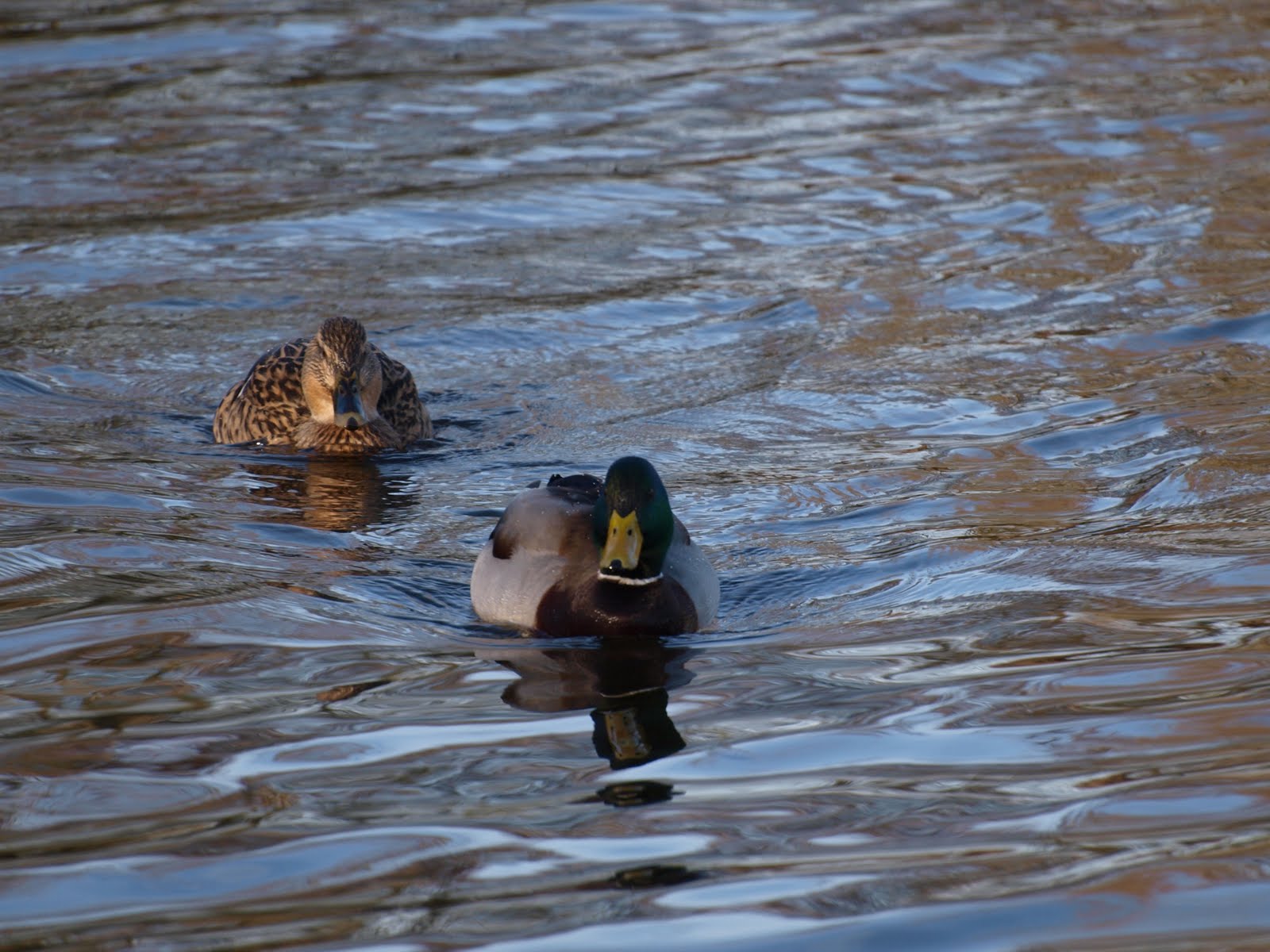
This drake Mallard was having a good scratch


I don't think I have ever seen so many Greylag Geese on the reserve - here's just two of them on a nearby island


A few more shots of Mallard


Tufted Duck


Another Mallard


There were hundreds of lapwings on Willow Island but unfortunately too far away to even attempt a photo.

I walked up to Carlton Hide which overlooks the Newlands Reedbeds hoping that there might be a bittern about - sadly no sign. In fact, the only birds were a couple of mallard and a moorhen.

I called in at East Marsh Hide but it was standing room only - most of the recent excellent bittern sightings have been seen from here. It didn't look as though anyone was going to vacate a seat in the near future so I didn't linger long!

The reserve was looking beautiful in the winter sunlight.


I paused by Grebe Pool hoping for a kingfisher and a couple of Canada Geese came over to say hello


I walked back to the car park via New Hare Covert and around the back of Grebe Pool. Highlights included a robin singing and male and female bullfinches.
A short-eared owl was seen several times over sheep field last year but I don't think it has been seen in 2011.

I dipped on the bittern (I think I'll try and persuade my husband to go to Ladywalk with me soon to try and see one - it might be quieter there!) and only managed to see 27 species but it was lovely walking on such a lovely day. 4 species were added to the year list - greylag goose, lapwing, teal and shoveler so I've managed to see over 50 now! ((I don't think I shall be breaking any records this year!!) I also added rabbit to the 2011 mammal list.

Saturday, 5 February 2011

Wootton Wawen

My son was on holiday yesterday and was keen to go on a circular walk around the Warwickshire village of Wootton Wawen situated 6 and a half miles north of Stratford-upon-Avon. It sounded a good idea especially as there is a Saxon church there which is one of the oldest (if not the oldest) in Warwickshire.

As we arrived the weather deteriorated with light rain falling so we decided to visit the the church of St Peter's first. A timber and thatched church was first built on this site between AD723 and 736 and then between 970 and 2040 Wagen, an Anglo-Danish landowner established the church that stands today.

St Peter's Church - the scaffolding is due to stonework repairs. The church is normally illuminated at night and when I've driven past on my way to Stratford it makes an impressive sight.


The octagonal font is fourteenth century and is decorated near the base with eight sculptured heads. The Victorian stained glass is set within a tracery window dated around 1300


Coat of Arms of George I, 1st Hanoverian king


The studded oak North door set in a fifteenth century archway


Thirteenth century window containing some of the original stained glass


Te Deum window 1905. The stone heads on each side of the window date back to the fourteenth century


Fifteenth century oak pulpit


I managed to take a picture of a stained glass window without flash!


The church holds Warwickshire's only chained library containing sixteenth and seventeenth century chained books housed in a seventeenth century long book-desk


The Saxon Sanctuary exhibition highlights key events in the history of Wootton Wawen


Thirteenth century parish chest


Memorial


Canopied Italianate Altar Tomb of Francis Smith (1522 - 1605)


In the next two photos traces of early fourteenth century red wall paintings can just be made out behind the monuments.


Legend suggests that the crosses engraved in the stone of the porch were made by pilgrims and crusaders - note my son had to point them out in case I missed them!


War Memorial


Wootton Wawen Lodge with Wootton Hall in the background


I rather liked this sundial on the side of a cottage


It was still trying to rain and the wind seemed to have got even stronger so, much to my son's disgust, I suggested we abandon the idea of a four mile walk and retire to a nearby hostelry for lunch - I do like my pub lunches!!!


The Bull's Head is probably sixteenth century - one of the fireplaces inside is dated 1697 but there is a building stone giving the date as 1317. It is certainly very old and one could almost imagine William Shakespeare sitting near one of the fires. I had a delicious (but unhealthy!) lunch of chips with aioli dip and David had cheese and branston on toasted ciabatta with chips.


I would love one of these carved wooden benches in my garden


I have a feeling we shall be visiting again as David is adamant he still wants to do the walk!

Reference: The Saxon Sanctuary Handbook

Thursday, 3 February 2011

Local Birding

I had to give my daughter a lift to Coleshill yesterday. Coleshill is a market town in North Warwickshire and I remembered that the parish church of St Peter and St Paul is open on Wednesdays between 11.00 and 1.00 p.m. The church has a superb twelfth century font and some medieval table tombs with effigies of knights so I decided to visit and take some photos. Unfortunately, the church is only open April to September so I had to abandon that idea and decided on a drive round the local lanes stopping off at various places.

It was freezing cold and, as I'd planned to walk round the church, I didn't have enough layers on for walking far so I didn't see too many birds - 3 buzzards, 3 pheasants and numerous chaffinches, blue tits, blackbirds, carrion crows and wood pigeons and several sightings of magpies carrying sticks to rebuild last year's nests.

Highlight of the trip was a field near Hams Hall Business Park which had a large flock of 50+ starlings, 20+ fieldfare and around half a dozen redwings. Redwing is a new bird for the year list. Still no sign of any waxwings on the berries at the business park but I did see more redwings and blackbirds feeding there.

My bird 2011 list stands at an embarrassingly low 46! - hopefully I will get out to a local nature reserve soon and see a few more species.

Garden Update

A few photos taken in the garden this morning

The flowers in patio pots have suffered with the cold and snowy weather but there are a few winter pansies flowering.


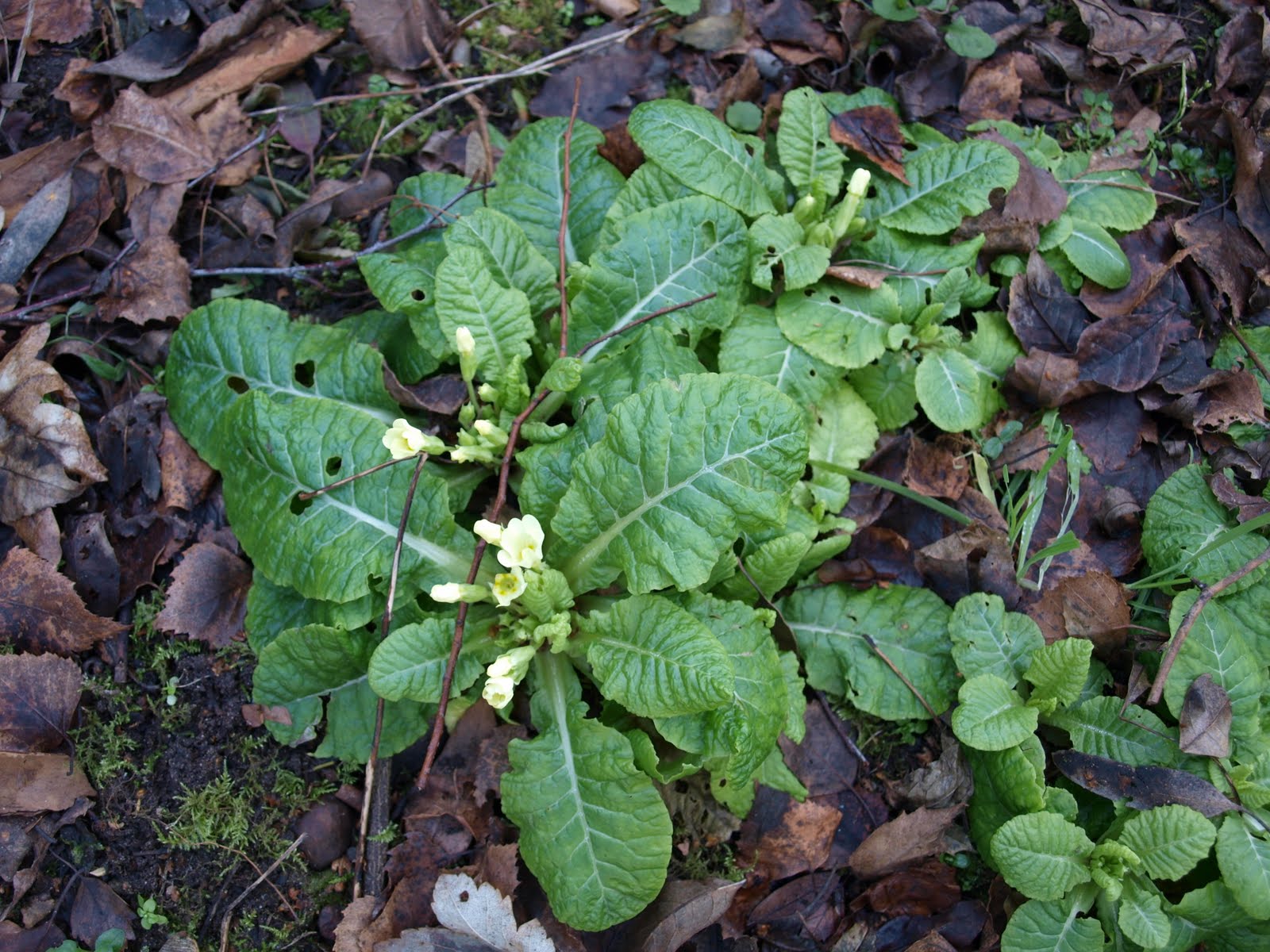
Clump of primroses coming into flower


The log pile in the wooded area at the top of the garden which started out as a "hedgehog" home is getting larger. Hopefully, it has provided winter shelter for invertebrates if not amphibians or hedgehogs.


Bluebell leaves are starting to shoot and I am not sure what species of bird met with a grisly end. Could it be a magpie?


Clematis seedheads are still clinging on and looking pretty in the winter sunlight