
Recently I was reminded of a bookshop - Astley Farm Bookshop - in North Warwickshire which is Warwickshire's largest second-hand bookshop containing 75,000 titles - well, of course I had to visit! So I went along with D last Sunday.

For a book lover this shop is just paradise - it is huge and the books are all well arranged with a massive fiction section in alphabetical order and then the non-fiction books by subject. To be honest on a first visit it is all a bit too much to take in and it is a place I will definitely be returning to.
There is also a rather good tearoom serving the most delicious cakes - we had Strawberry and White Chocolate Gateau and the servings were very large! Sorry no picture - unfortunately I had left my camera in the car.
I did make two purchases - the book by Timpson I have been looking for for ages.


I have thought about visiting Astley Church in the past and it is open on Sundays between 2.00 and 3.30 p.m. when there is a service so we stopped off in the village on the way home.
There is a lovely story connected to the original 1343 church which was built in the shape of a cross with a lead-covered spire on top of a central tower. At night-time a light was lit from the spire called "The Lantern of Arden" to guide people through the huge forest which covered the area in those days.
Today there is a new "Lantern of Arden" created by artist Johnny White as part of the North Arden Heritage Trail. It is built from red sandstone (the same as the church). Parts of the lantern are inspired by the church - stainless steel panels mirror ancient themes and the history of the village; George Elliot, Astley Castle and 3 queens are also commemorated.


St Mary the Virgin Church

A church has existed on this site from 1285. The church today contains remains of some of the church built in 1343 as a chantry for Sir Thomas Astley and alterations and additions were made in 1607/08.
Unfortunately because we had dallied over tea and cake it was nearly 3.00 p.m. so I only had about 15 minutes to have a quick look round the church.
Altar and East Window

The Triptych is Flemish and given to the church by the Newdigate family.

The North and South Chancel windows hold remnants of stained glass from the original East Window.


The Venetian Gondola lanterns were given to the church in 1903 by Sir Francis Newdigate.


Above the stalls are painted Apostles and Prophets.


The walls of the Nave contain nine very beautiful 17th century painted texts showing quotes from the Bible and Prayer Book. They were conserved in 2010 by Tobit Curties Associates.


Original East window of the church on display high on the wall between Nave and Chancel.


The Grey Monument consists of 3 alabaster effigies (originally there were nine).
On the far left is an effigy of Cicely Bonville d1530 - 2nd wife of Thomas Grey, eldest son of Elizabeth Woodville from her first marriage. He was made Marquis of Dorset by Edward IV (who had married Elizabeth after the death of her first husband). Cicely and Thomas's eldest son was the grandfather of Lady Jane Grey.
In the centre the effigy is believed to be Elizabeth Talbot d 1483, wife of Edward Grey's young son Edward Lord Lisle.
On the the right is a representative of Sir Edward Grey d1437 - in the photo of the picture on the church wall showing the tomb from above you can see a stylised lion at his feet.


A headless brass of a woman who died c.1535.

I bought a few postcards as I was leaving and realised I had missed the 14th century misericords - too late to go back and get photos as more and more people were arriving for the service so here is a photo of a few on a postcard. There are 18 altogether!

I also missed the floor tiles but no postcard of those.
Post card of a painting of the church by Miles Sharp (1887 - 1973) - Principal of Nuneaton School of Art

Photo of another post card of a painting by Roger Orton of Nuneaton.

George Elliot, the author, was born within a mile of the village of Astley and in her novel "Scenes of Clerical Life: Mr Gilfil's Love Story" the village of Knebley in the novel is based on Astley and the castle here is used as Knebley Abbey. Her parents were married at the church in February 1813.
What look like old bricked up doorways in the side wall - I believe one of them originally led to a 14th century chapel.

The South Door and Porch are believed to be 17th century built when the church was altered in 1607.


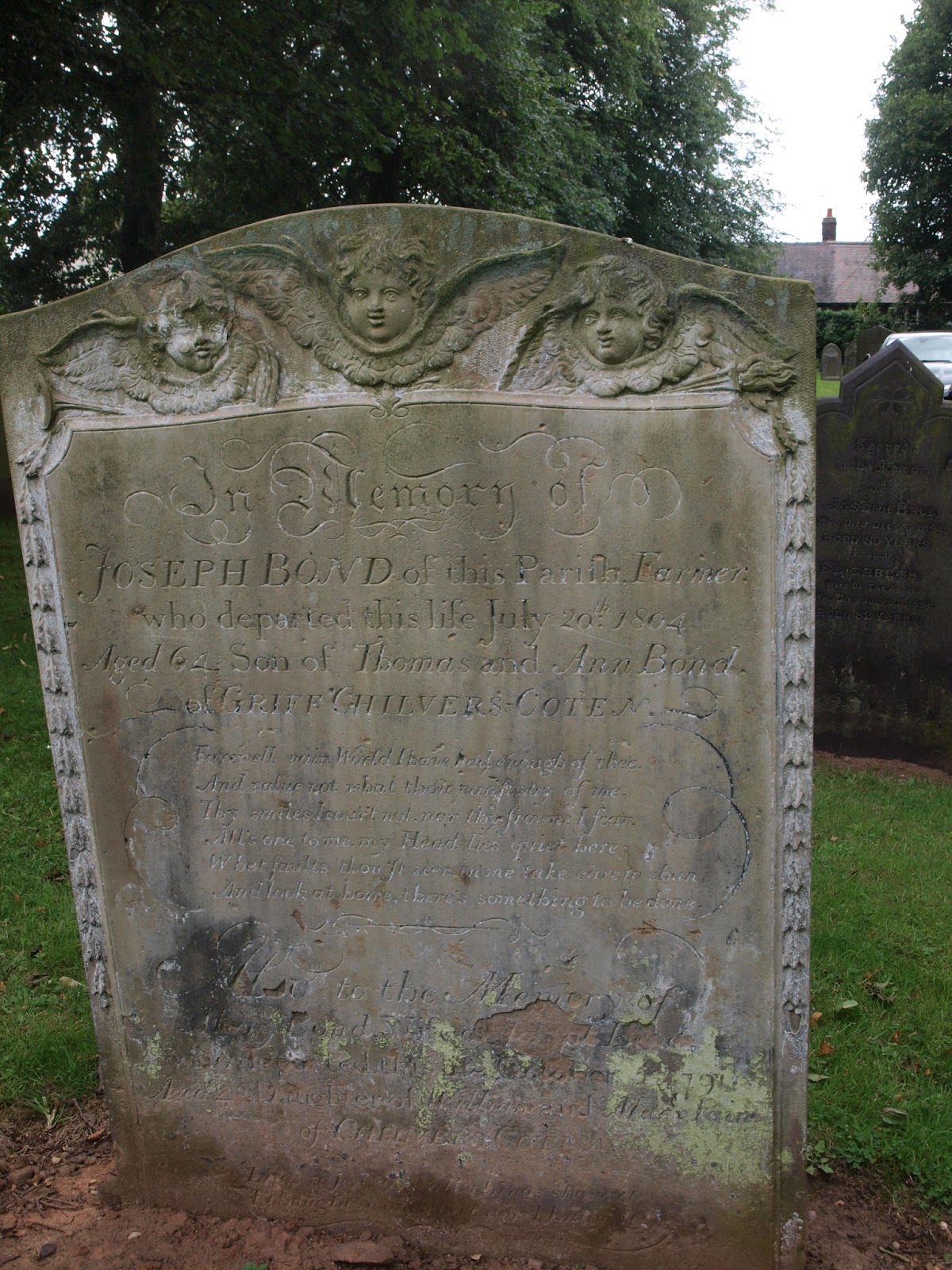
Gravestones of varying ages.




Astley Castle

The Astley family held the Manor of Astley from the 12th century. The original castle was possibly built in 1170 by Philip Astley. Sir William Astley died in 1420 leaving the estate to his daughter who was married to Reginald Grey, 3rd Baron Grey de Ruthvyn who was a Border Lord from the borderlands between England and Wales. The Grey family rebuilt the castle (the building that can be seen today) in 1555. The Grey's lost the castle (after proclaiming Lady Jane Grey Queen - see below) and it was sold by the Crown.
The castle has connections with three English Queens. In 1452 when she was 15 Elizabeth Woodville (1437 - 1492) married John Grey and lived at the castle in the mid 15th century. John Grey died fighting for the Lancastrians at the Battle of St Albans in 1461 during the War of the Roses. Elizabeth was later wooed by Edward IV, the Yorkist's claimant to the throne and married him in 1464 when she became Queen. Two of her sons were the Young Princes who later died in the Tower. Some of you may have read The White Queen by Philippa Gregory (a book I had sorted out to take to the charity shop but have now retrieved!). Elizabeth's daughter, Elizabeth of York, became Queen in 1486 when the married Henry VII. Frances Brandon, grand-daughter of Elizabeth of York married Henry Grey and their daughter Lady Jane Grey was put on the throne in 1553. Her reign lasted 9 days. She, her father and husband were executed in 1554.
The castle was an important parliamentary stronghold during the Civil War. In the 1960's it became a hotel but was devastated by fire in 1978. It is currently being restored by The Landmark Trust after standing derelict for many years.

The castle is surrounded by a moat and mossy walls can be seen along the inner edge - possibly remnants of the original castle.

Dark Lane near the Castle leads to a holloway. These are made by the passage of people and vehicles over centuries which case a hollowing of the road which collects water speeding up the process of erosion. Eventually the holloway is well below the level of surrounding land and from the depth of this one it is believed to date back to medieval times. To be honest I always connect holloways with counties like Dorset so it was a pleasant surprise to discover one in Warwickshire! Sadly, I didn't have time to explore far as I had no idea where D had gone while I was in the church and it was time to go and look for him.


The castle is open occasionally (Heritage weekend in September is I think the next occasion) so I will go back at some stage to see more of the castle and church and walk around the castle trail and along the Holloway.
Sculpture seen in the village of Fillongley on the way home. It is entitled "The Family" and was erected in 2011. The sculptor/designer is Graeme Mitcheson and the statue is made of Kilkenny Limestone.

Green Man pub sign in Coleshill

*D - Photos taken by D with the Canon SX50
Reference
Various information boards at the church and castle
and
Leaflet on St Mary the Virgin Astley Church


