Waxwing

Waxwing
"To see a world in a grain of sand,
And a heaven in a wild flower,
Hold infinity in the palm of your hand
And eternity in an hour."

From "Auguries of Innocence"

by William Blake
Showing posts with label Hampton in Arden. Show all posts

Tuesday, 15 March 2022

Hampton in Arden - Packhorse Bridge and Church


D and I visited Meriden last weekend to go a short walk by the Packhorse Bridge and its Nature Reserve.


Viaduct over the River Blythe


15th century Packhorse Bridge


Wall letter boxes in the village - one in Marsh Lane and one in the wall of the newsagents and post office.


The White Lion - a local pub I have for once not been in!


D wanted to go in the village shop as we had run out of bananas so I parked by the Parish Church of St Mary and St Bartholomew and went for a wander round the churchyard.

A group of church crawlers on Twitter have fun spotting traffic cones by churches hence this photo.


The chancel is Norman but there have been alterations over the centuries. The tower once had a spire until it fell in 1643.


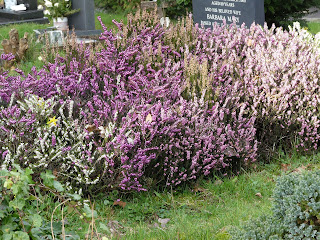
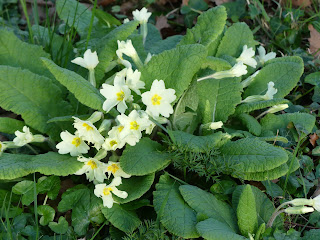
There were many flowers in the churchyard - snowdrops, crocuses, daffodils, primroses and heather.






When D emerged from the shop I persuaded him to go in the church porch to see this lovely memorial stained glass window with wild flowers and butterflies.


The church door is I think about 400 years old.


Stained glass showing local buildings.


To my amazement D disappeared in the church.  He's been studying Gothic architecture on his current OU course and has recently been far more interested in churches and cathedrals which is a first!   Not too many photos as we didn't stay that long.


This is part of the very beautiful Nora Yoxall and Elsie Whitford window.


Modern stained glass window by John Hayward 1968 showing the risen Christ bringing light to the souls of the dead.


Kneelers including one of a Green Man.


Carved heads on a capital - I am sure on a previous visit the vicar mentioned they were supposed to be based on 14th century Hamptonians.


Part of the rood screen given in memory of Frederick Peel, son of prime minister Sir Robert Peel who founded the police force. Frederick lived at Hampton Manor from 1855 until his death in 1906. and this church was his parish church. The figures represent Christ, his mother Mary and St John.


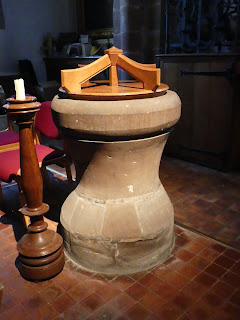
I haven't been able to discover how old the font is but the cover looks fairly modern compared to the font.


To see far more of the church interior with better photos of the stained glass please see my post on St Mary and St Bartholomew church interior  and for more of the churchyard from my visit last year please see this post St Mary and St Bartholomew churchyard  The church was locked last year so it is good that it is now open again.

I do hope everyone is staying safe and well.

No photos from D this time he had forgotten to put the card in the camera!


Monday, 29 March 2021

Spring Flowers in a Country Churchyard


Desperate to see some Spring flowers and wild flowers I've paid a visit to the local church of St Mary and St Bartholomew, Hampton in Arden.

The chancel of the church is Norman c1130 and the west tower Perpendicular.  The tower once had a spire but it collapsed in 1643.

The churchyard was fairly quiet although I did see a few other people walking through.


There were daffodils galore.

"Daffy Down Dilly has come up to town

In her Yellow Petticoat and her Green Gown."


The churchyard on the North side was covered in Lesser Celandines and Primroses just as I had hoped.

Lesser Celandine Ranuculus ficaria is one of the first wild flowers to appear in Spring flowering between March and May.  According to John Clare, the poet, children called them "Golden Daiseys".  Lesser Celandine is also known as Pilewort, Golden Guinea, Golden Stars, Star Flower, Bright Eye, Scurvywort and Butter and Cheese.  The flowers close when it rains and is cold only opening when the sun apppears.  In the Language of Flowers it represents "joys to come".  It was the favourite flower of the poet William Wordsworth who asked for it to be engraved on his gravestone but the stone mason got it wrong and William ended up with a Greater Celandine instead!


I found just one Snakeshead Fritillary - a white one.


Daisy Bellis perennis 

Daisies are said to represent Mary's tears as when she was picking the flowers for the baby Jesus she pricked her finger and the pink tinge to the petals was caused by her blood.  Children for years have made daisy chains and it is the flower of the newborn in some areas where it is referred to as "bainwort" because legends suggested a daisy chain could stop fairies carrying away the baby.

The flowers close up at night and when it rains. Local names include "Billy Button" and "Hens and Chickens".


I found a few violets.  Violets represent humility and are also an emblem of constancy and steadfastness.  Romans used violets to make wine and a wreath composed of them cured a hangover!  Today crystallised petals are often used as cake decorations.


A type of pussy willow catkin.


Beds of Heather


Grape Hyacinths


Crocuses


Forsythia


Despite the sunshine and warmth and flowers I failed to see a single butterfly or bee!


Churchyard Angels


Interesting rain heads


Old Doors


Green Man


15th century base of a cross - octagonal with quatrefoil panels.


I first looked round the church a few years ago and was surprised it was open. Of course at the moment it is locked but if you want to see inside the church (there is some lovely stained glass) please use this link St Mary and St Bartholomew


Opposite the church is the White Lion - a pub I've not been in. Closed at the moment but I noticed the wine merchants nearby was doing a roaring trade.


I hope everyone is staying safe and well.

All photos taken by me with the Panasonic Lumix FZ330 bridge camera.


References:

"Discovering the Folklore of Plants" by Margaret Baker

"Britain's Wildflowers : A Treasury of Traditions, Superstitions, Remedies and Literature" by Rosamond Pilcher.